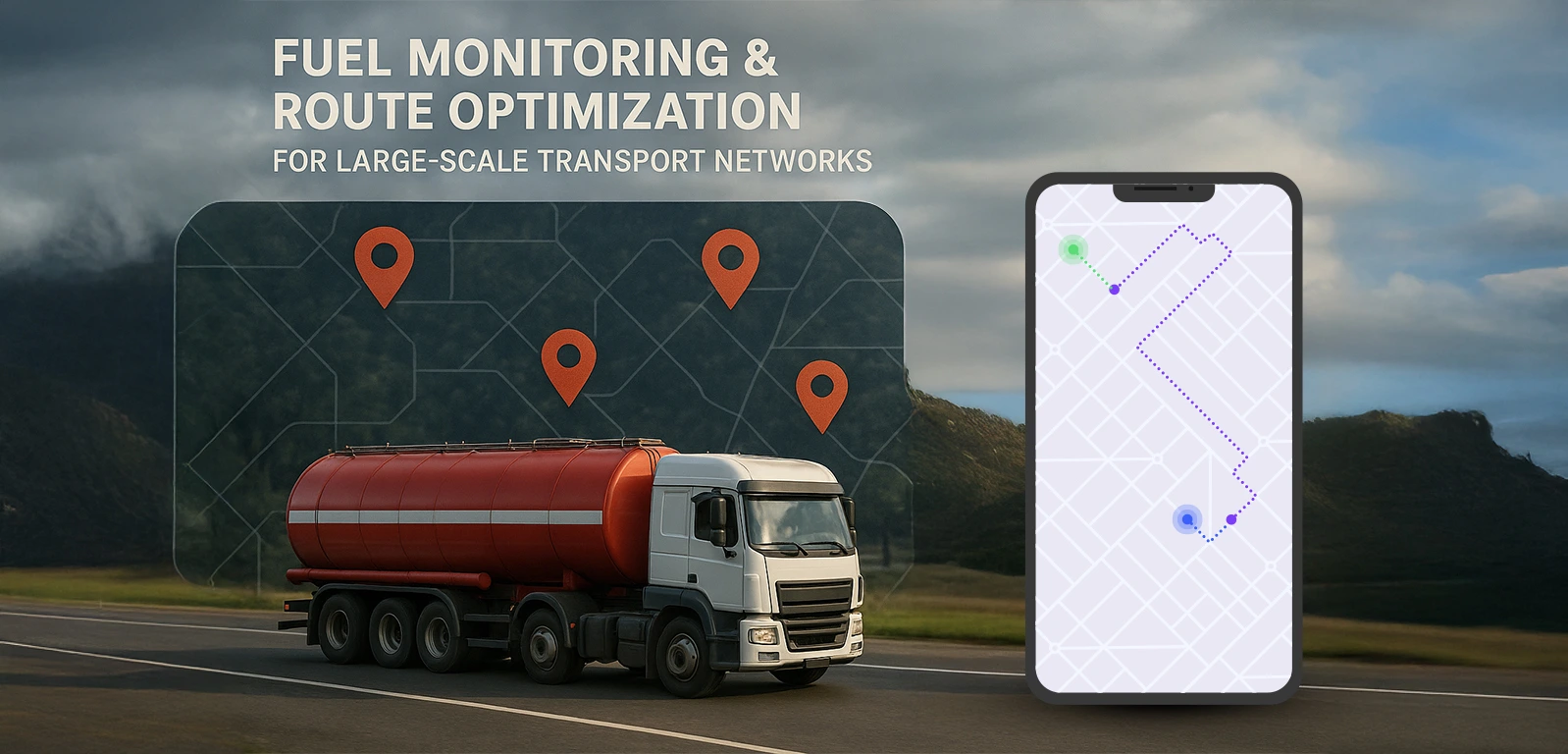
In large-scale transport, efficiency equals survival. With razor-thin margins and fierce competition, success depends on mastering two essentials: minimizing fuel consumption and maximizing route efficiency.
A robust fuel monitoring system for transport fleet combined with dynamic route optimization software for enterprise fleets is the key to unlocking millions in savings and achieving operational excellence. Relying on traditional methods, such as paper logs and manual route planning, is no longer sustainable. Today, the convergence of advanced IoT sensors and intelligent analytics is giving enterprise fleets the power to turn these historically large cost centers into major sources of savings.
Why fuel cost remains one of the largest operating expenditures in transport
Fuel consumption consistently ranks as the single largest controllable expense for large transport networks, often accounting for 25% to 40% of total operating expenditure. The reasons for this high cost are manifold:
Market Volatility: Global oil prices are inherently unstable, meaning small fluctuations translate into enormous costs across thousands of kilometers. With hundreds or thousands of vehicles on the road for long hours, even a small variation in fuel efficiency becomes large in absolute terms.
Operational Inefficiencies: Excessive idling time, aggressive driving (harsh acceleration/braking), and unauthorized vehicle usage directly waste fuel.
Pilferage and Theft: Unmonitored fuel tanks remain highly vulnerable to siphoning, which is difficult to detect without accurate data.
Suboptimal Routing: Non-optimized, longer routes mean more mileage, more time on the road, and predictably higher fuel consumption.
For any organization focused on fleet fuel management large scale, addressing these factors is paramount to financial health.
The role of real-time fuel monitoring sensors + telematics data
To move from reactive cost reviews to proactive fuel management, two technologies converge: fuel-level sensors in the vehicle (or asset) and telematics (GPS + behaviour + vehicle diagnostics). Together they enable what is often termed a "fuel monitoring system for transport fleet".
Key capabilities include:
High-Precision Sensors: IoT-based capacitive or ultrasonic sensors are installed directly in the fuel tank to track level changes in real time, offering a digital, tamper-proof log of every refill and drop. Roadcast's sensors instantly alert operators to sudden fuel drops—signs of theft or siphoning.
Fuel Consumption Analytics: The system correlates fuel data with distance, idling, and driver behaviour to establish baseline consumption and flag anomalies, such as a vehicle using 15% more fuel than peers.
Idling & Wastage Reports: Integrated telematics detect excessive idling or engine-on stationary periods, helping reduce unnecessary fuel burn and improve vehicle discipline.
Fleet Platform Integration: Roadcast's hardware-agnostic solution unites fuel data with routes, driver profiles, and load status. This fusion enables context-aware insights—linking fuel drops to vehicle location or ignition status to detect unauthorized siphoning.
Driver Behaviour Correlation: The platform ties individual driver scores (speeding, harsh braking) to fuel efficiency metrics, allowing targeted coaching and performance incentives.
Fast ROI: With fuel comprising up to 30% of operating costs, savings of just 5–10%—as reported by MotorIndia—deliver rapid and measurable returns, making real-time fuel monitoring a high-impact investment for enterprise fleets.
Route optimisation at scale: dynamic vs static routing, multi-stop, proof-of-delivery
Once you have fuel visibility, the next lever is route optimisation software for enterprise fleets. At large scale, routing isn't simply "shortest path" — tells you how much fuel you should be using. For enterprise networks, this involves sophisticated planning:
Static routing: Pre-planned routes executed routinely (e.g., daily pickups). These are still valuable, but they assume traffic and conditions stay similar.
Dynamic routing: Dynamic routing enables real-time rerouting based on live events—traffic, accidents, or last-minute changes—allowing dispatchers to react instantly, cut delays, and prevent costly fuel waste across large fleets.
Multi-Stop & Proof of Delivery (POD): Route optimisation ensures the stops are sequenced for minimum travel time. Integration with mobile POD systems confirms the delivery was made at the correct location and time, closing the operational loop and improving overall transport network analytics fuel savings.
Multi-stop and Proof of Delivery
Enterprise fleets run complex multi-stop routes, demanding software that optimises capacity, timing, and proof of delivery. Scalable route optimisation cuts kilometres, fuel, and maintenance costs—improving OTIF and driver efficiency. Integrated with fuel monitoring, it compares "actual vs planned" use, enabling smarter, data-driven operational decisions and up to 30% fuel savings.
Case Study: Enterprise Transport Network Uses Roadcast to Trim Fuel Spend
A major national enterprise transport network faced spiraling fuel costs despite a large investment in standard GPS tracking. They partnered with Roadcast fuel & route optimisation enterprise to implement a unified solution:
1. Deployment: High-precision fuel sensors were installed across the fleet and integrated with the Roadcast platform.
2. Analysis: Initial analytics revealed that 6% of monthly fuel volume was being lost to a combination of tank pilferage at remote parking yards and excessive idling time near customer premises.
3. Optimization: The fleet adopted Roadcast's dynamic route optimization for all multi-stop runs and implemented driver coaching based on fuel-efficiency scores.
Result: Within eight months, the company achieved a 7.2% reduction in overall fuel spend, with 3% directly attributable to eliminating pilferage and the rest coming from reduced idle time and optimized mileage. This translated into millions in annual savings, far outweighing the initial technology investment.
Implementation roadmap: hardware, data integration, change management
Deploying such a solution in a large-scale transport network requires planning across hardware, software and organisational change.
1. Hardware & Sensors
Choose compatible fuel-level sensors (e.g., Roadcast LLS4, Escort BT).
Install telematics/vehicle tracking devices and ensure connectivity, data flow, and calibration.
2. Data Integration
Merge fuel, telematics, diagnostics, and driver behaviour data.
Connect with dispatch/route optimisation software.
Build dashboards for fuel level, refuelling, consumption/km, idling, and route efficiency.
Maintain clean data with validated IDs and timestamps.
3. Route Optimisation Rollout
Audit current routes, kms, and fuel use.
Model "what-if" scenarios and pilot with select vehicles.
Integrate driver apps for live updates and proof of delivery.
4. Change Management
Train teams, define KPIs, and review regularly.
Reward efficient drivers and enforce governance on fuel and routes.
5. Scale & Improvement
Expand fleet-wide, add constraints, apply ML for efficiency, and review every six months.
KPIs and Dashboards Every Operations Leader Should Track
A robust system provides more than just data; it provides actionable Key Performance Indicators (KPIs) through easy-to-read dashboards:
Fuel Efficiency: Actual MPG/KPL vs. Target MPG/KPL, broken down by vehicle type and driver.
Idle Time: Total daily idle time across the fleet, and Idle Time % of Total Engine Hours.
Route Adherence: Percentage of trips that adhered strictly to the optimized route vs. those that deviated.
Unauthorized Fuel Loss: Daily report detailing instances of sudden fuel drops correlated with engine-off status and location.
Cost Savings: Running ROI dashboard showing fuel cost reduction achieved month-over-month.
Dashboards should visualise these metrics across fleets, vehicle types, geographies, driver cohorts and over time. Alerts should highlight outliers (e.g., vehicles consuming 20% more fuel than peer group) so corrective action can be taken quickly.
Conclusion
In an age of rising costs and shrinking margins, fuel monitoring and route optimisation have become strategic essentials for large-scale fleets. By integrating real-time sensors, telematics, and intelligent routing, operators can reduce fuel expenses, boost utilisation, and enhance service reliability. With the right implementation roadmap and KPI-driven dashboards, fuel transforms from a cost burden into a controllable metric. Roadcast's enterprise solutions deliver visibility, efficiency, and data-driven control—empowering transport leaders to achieve sustained operational excellence.