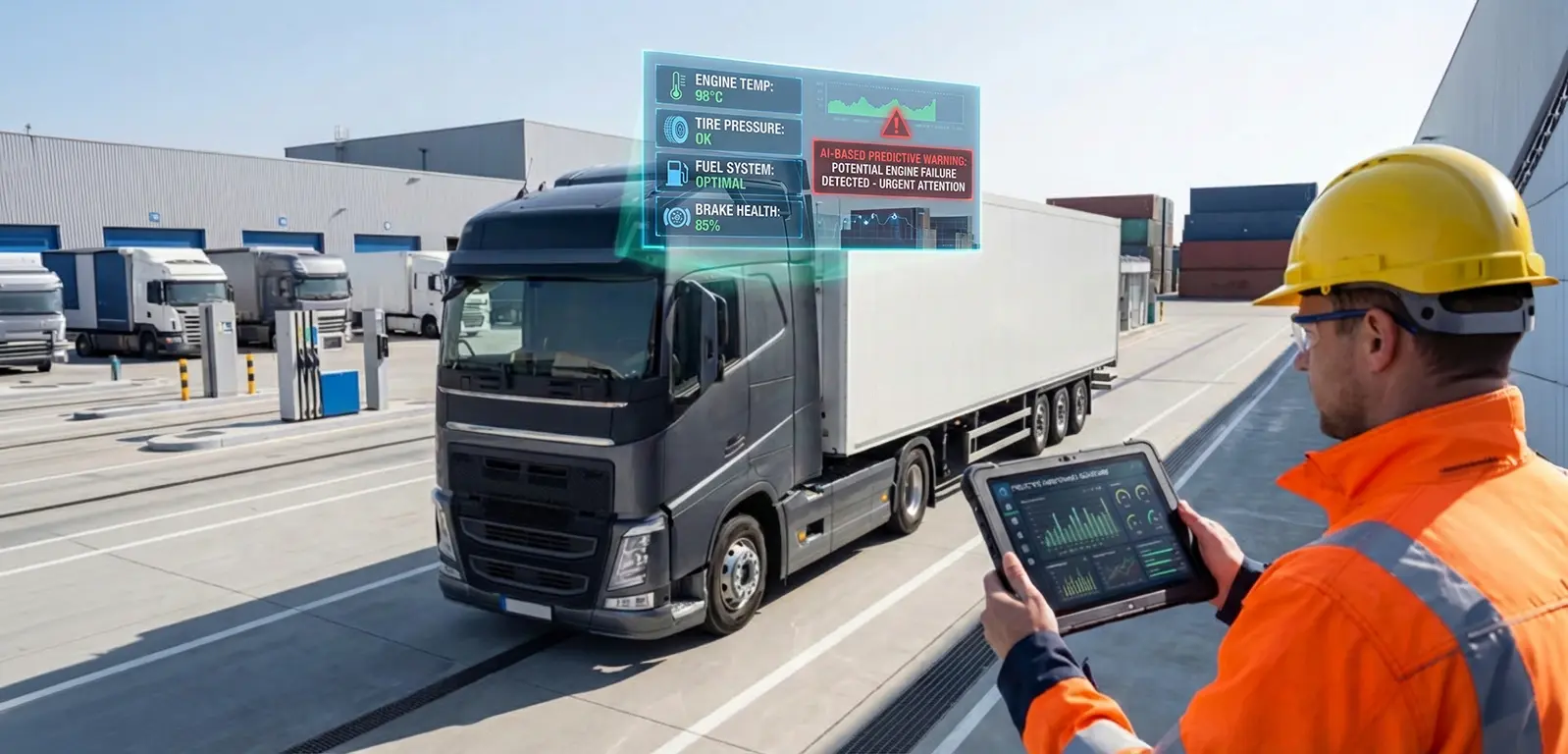
Unplanned breakdowns are among the most expensive failures in enterprise fleet operations. Predictive maintenance telematics replaces guesswork with certainty—anticipating failures before they disrupt operations.
A single vehicle breakdown is more than a repair expense—it triggers cascading losses across deliveries, SLAs, driver productivity, and customer trust. In enterprise logistics in 2026, a breakdown isn't a mechanical event; it's a systemic disruption that ripples across the supply chain through missed windows, detention fees, and emergency repair costs. Yet many fleets still rely on fixed-interval preventive maintenance built for a simpler era. That model has reached its limit. Predictive maintenance telematics replaces guesswork with certainty—using real-time sensor data and usage patterns to anticipate failures before they disrupt operations.
Why Preventive Maintenance Fails at Scale
Preventive maintenance assumes all vehicles age the same way—but in enterprise logistics, that rarely holds true. Even identical vehicles can experience very different wear depending on route conditions, load patterns, driving behavior, idle time, and operating hours. While manual oversight may work for small fleets, fixed service intervals at scale often lead to over-maintenance of healthy vehicles and under-maintenance of high-stress ones. Both outcomes increase costs and downtime, which is why large fleets increasingly rely on fleet maintenance analytics instead of simple odometer-based schedules.
Sensor + Usage-Based Triggers
Modern telematics systems transform vehicles into continuously monitored assets. Through a combination of onboard sensors and usage data, fleets can track:
- Engine hours vs distance
- Coolant temperature anomalies
- Battery voltage degradation
- Harsh driving patterns
- Extended idling behavior
These signals act as early-warning indicators, triggering maintenance actions based on actual vehicle health rather than assumptions. For example:
- A vehicle with low mileage but high engine hours may require earlier servicing.
- Repeated overheating events can indicate cooling system issues before failure.
- Battery health trends can signal replacement needs weeks in advance.
This approach enables true vehicle health monitoring at the enterprise level, where maintenance decisions are grounded in real operating conditions.
Sensor + Usage-Based Triggers: The New Foundation
Modern vehicle health monitoring enterprise solutions move beyond simple odometers. They leverage the vehicle's CAN bus to monitor hundreds of data points simultaneously. By 2026, predictive triggers have evolved into two main categories:
- Usage-Based (UBM): Maintenance triggered by actual engine load, fuel burn, and idle time rather than just kilometers.
- Secondary Sensor Signatures: Analyzing "sub-threshold" data. For example, a telematics system might detect a microscopic increase in starter motor current draw over five starts. This isn't enough to trigger a dashboard light, but the fleet maintenance analytics engine identifies it as a probability of a total starter failure within the next 14 days.
These two layers together give enterprise fleet teams the earliest possible warning window—turning reactive repairs into scheduled, low-disruption interventions.
Maintenance Intelligence Workflows
Data alone does not prevent breakdowns—workflows do. Predictive maintenance becomes operationally effective only when insights flow directly into maintenance execution. Leading enterprises implement maintenance intelligence workflows that connect telematics data with action. A typical workflow includes:
- Detection: Sensor data identifies abnormal patterns.
- Diagnosis: Analytics correlate anomalies with historical failure models.
- Prioritization: Vehicles are ranked by risk severity and operational impact.
- Action: Maintenance tickets are automatically generated.
- Verification: Post-service data confirms issue resolution.
This closed-loop system replaces reactive firefighting with proactive planning. Instead of emergency repairs, fleets schedule interventions during low-impact windows—reducing both downtime and disruption.
Downtime Cost Modelling
One of the strongest arguments for predictive maintenance is its financial clarity. Downtime costs go far beyond repair invoices. A single unplanned breakdown can include:
- Missed or delayed deliveries
- Penalty clauses and SLA breaches
- Idle drivers and substitute vehicle costs
- Customer dissatisfaction
- Secondary damage due to cascading delays
Downtime cost modelling assigns a monetary value to these factors, helping enterprises quantify the true cost of failure. When fleets model downtime accurately, predictive maintenance investments become easier to justify. Preventing even a small percentage of breakdowns often delivers ROI that far exceeds maintenance analytics costs.
This is where a mature telematics maintenance system moves from operational tool to strategic lever.
Enterprise Rollout Strategy
Implementing predictive maintenance at scale requires more than installing devices. Enterprises that succeed follow a phased rollout approach.
1. Start with High-Impact Assets
Focus first on vehicles that:
- Cover the highest mileage
- Serve critical routes
- Have the highest historical breakdown rates
2. Define Health Baselines
Establish normal operating ranges for key parameters. Predictive systems work best when "normal" behavior is clearly defined.
3. Integrate Maintenance Systems
Connect telematics insights with existing ERP, CMMS, or workshop workflows to avoid parallel processes.
4. Train Teams on Interpretation
Maintenance intelligence must be understood by operations, not just IT. Training ensures alerts lead to action, not confusion.
5. Scale with Confidence
Once validated, expand across the fleet with standardized workflows and governance.
From Maintenance Schedules to Maintenance Intelligence
The future of fleet maintenance is not about more frequent servicing—it's about smarter servicing. Enterprises that adopt predictive maintenance using telematics gain:
- Fewer unplanned breakdowns
- Lower maintenance costs
- Higher vehicle uptime
- Improved safety and reliability
- Better capital utilization
As fleets grow larger and margins tighter, maintenance can no longer remain reactive or schedule-driven. Intelligence-led maintenance is fast becoming a competitive necessity.
Conclusion
In modern logistics, breakdowns are rarely unavoidable—they're often predictable. By combining telematics data, sensor intelligence, and analytics-driven workflows, enterprises can shift from reacting to failures to preventing them. Predictive maintenance turns maintenance from a cost center into a strategic advantage, keeping vehicles on the road and operations running smoothly. In 2026, the most efficient fleets aren't fixing trucks faster—they're preventing failures altogether through planned, data-driven service cycles.