A common sight on Indian roads is two opposing parties arguing over an accident. Accusing each other of being the delinquent, it sometimes even leads to violent brawls. How does one exonerate oneself in such a situation? The answer is ADAS technology.
What is ADAS and Why Does It Matter for Indian Trucks & Buses?
ADAS technologies encompass advanced features designed to assist drivers, leveraging sensors, cameras, and AI-driven algorithms to enhance safety. Learn more about ADAS features.
When an accident occurs, a few seconds of clear dash-cam footage can do far more than protect an asset—it can preserve a driver’s reputation, maintain the integrity of a fleet, and shift the outcome of legal exposure. Exoneration is the foundational element of modern fleet safety.
Before we delve into the ADAS solution, let's take a hard look at the statistics on Road accidents in India.
As stated in a study reported by The Economic Times, India experiences the highest count of road accidents globally, accompanied by a fatality rate of 11%. It is concerning to note that more than 170,000 individuals succumb to road accidents annually, most of which are due to irresponsible driver behavior and can be avoided. 60% of the fatalities occur on highways. Driver fatigue is the single largest contributing factor in highway accidents involving commercial vehicles.
MoRTH's Mandate — What's Changing and When?
In a direct response to India’s grim road safety statistics, the Ministry of Road Transport and Highways (MoRTH) has mandated the installation of Advanced Driver Assistance Systems (ADAS) for heavy commercial vehicles. According to the latest notification, the new safety norms will apply to Category N3 (heavy goods vehicles) and Category M3 (heavy passenger vehicles, such as buses). The mandate comes into effect on October 1, 2027. From this date, all new heavy trucks and buses sold in the country must be equipped with these active safety features.
While the October 1, 2027, deadline applies to new models introduced after that date, the government has also laid out a roadmap for existing models. Vehicles already in production and on sale will need to be upgraded to meet these norms by April 2028.
The mandate focuses on active safety - systems that intervene before a crash happens rather than just protecting occupants after impact.
Core ADAS Features Every Commercial Fleet Needs
The Ministry of Road Transport and Highways (MoRTH) has announced that all new buses and trucks must be equipped with the following ADAS features:
- Advanced Emergency Braking System - This technology uses radar and sensors to detect obstacles or vehicles ahead. If the driver fails to react to a potential collision, the system automatically applies the brakes to either prevent the crash or significantly reduce the impact speed. For highway trucks carrying heavy loads, this feature alone could prevent thousands of rear-end pile-ups common on foggy winter mornings.
- Driver Drowsiness and Attention Warning System - This tracks driver behavior to detect signs of sleepiness, a major killer on long-haul routes, by providing warnings/alerts.
- Lane Departure Warning System - This system alerts the driver via visual or acoustic signals if the vehicle begins to drift out of its lane without the turn signal engaged. Thus, it alerts the driver when the vehicle unintentionally drifts out of its lane.
- Blind Spot Detection System - Enhances detection of pedestrians and cyclists in blind spots.
Forward Collision Warning (FCW)
It continuously calculates the closing speed between the vehicle and whatever is ahead of it. When the algorithm determines that a collision is imminent unless the driver brakes immediately, an audio alert fires in the cabin — loud, specific, and designed to cut through driver distraction or fatigue in the critical seconds before impact. In a scenario where the driver is drowsy or distracted and hasn't noticed a vehicle braking ahead, this warning can be the difference between a near-miss and a fatal accident.
Lane Departure Warning System (LDWS)
Driver Drowsiness Detection monitors the vehicle's position relative to lane markings. When the vehicle drifts out of its lane without an active turn signal — one of the most reliable early indicators of driver fatigue or distraction on highway sections — an alert fires immediately. On Indian national highways, where lane discipline is inconsistent and two-wheelers frequently occupy the shoulder, unintended lane departures are a significant cause of accidents.
Pedestrian Detection
It provides alerts in urban and semi-urban environments where the density of non-motorized road users — pedestrians, cyclists, auto-rickshaws — creates constant cross-traffic risk.
How ADAS Reduces Fleet Accidents — Real Numbers
Let’s apply conservative estimates to India’s accident data.
Current baseline (India):
- 480,000 accidents per year
- 173,000 deaths per year
Lane Departure Warning System (LDWS)
LDWS alerts the driver via visual or acoustic signals if the vehicle begins to drift out of its lane without the turn signal engaged. On Indian national highways, where lane discipline is inconsistent and two-wheelers frequently occupy the shoulder, unintended lane departures are a significant cause of accidents.
Blind Spot Information System (BSIS)
Enhances detection of pedestrians and cyclists in blind spots — a critical feature given the larger blind spots and longer stopping distances of commercial vehicles, especially in congested urban areas.
Forward Collision Warning (FCW)
FCW continuously calculates the closing speed between the vehicle and whatever is ahead. When the algorithm determines that a collision is imminent unless the driver brakes immediately, an audio alert fires in the cabin — loud, specific, and designed to cut through driver distraction or fatigue in the critical seconds before impact. In a scenario where the driver is drowsy and hasn't noticed a vehicle braking ahead, this warning can be the difference between a near-miss and a fatal accident.
Pedestrian Detection
Provides alerts in urban and semi-urban environments where the density of non-motorized road users — pedestrians, cyclists, auto-rickshaws — creates constant cross-traffic risk.
How ADAS Reduces Fleet Accidents — Real Numbers
Let's apply conservative estimates to India's accident data.
Current baseline (India):
- 480,000 accidents per year
- 173,000 deaths per year
If ADAS adoption reaches a meaningful share of vehicles in the next five years, even a 10–20% reduction in crashes could have a massive impact.
Estimated 5-year impact (annual prevention potential):
- 48,000 – 96,000 accidents prevented per year
- 240,000 – 480,000 accidents prevented over five years
- 17,000 – 35,000 lives potentially saved
These are conservative estimates. As ADAS penetration grows in both passenger cars and commercial fleets, the impact could become even larger. A study also shows that vehicles fitted with basic ADAS features had a 19% reduction in property damage claims and a 27% reduction in bodily injury claims.
Choosing the Right ADAS Solution for Your Fleet
While most advanced driver assistance systems feature similar technologies, no two are the same. Some include features to ensure optimum driving safety; others offer only basic technologies with the option to add more.
Technical specifications to look for in a Dashcam:
- Channels: Dual Channel (Front + Internal Cabin)
- Front Camera: 1080P resolution, ADAS support
- Cabin Camera: 720P/1080P IR night vision with DMS (Driver Monitoring System)
- Field of View (HFoV): 116°
- Frame Rate: Total 1080P at 100 fps
AI & Driver Monitoring Features:
- ADAS: Lane Departure, Forward Collision Warning, Headway Monitoring
- DMS: Fatigue Driving Detection, Phone Use Detection, Smoking Detection, Lens Covered Detection
Roadcast ADAS Dashcam — Built for Indian Roads
Unlike highly structured Western driving environments, Indian roads present a completely different challenge:
- High-density, mixed traffic (cars, trucks, two-wheelers, pedestrians, animals)
- Overloading
- Poor lighting in many areas
- Frequent exposure to dust, fog, rain, and glare
- Poor quality of road surfaces (other than on major highways)
- Larger blind spots and longer stopping distances, especially in congested urban areas
Vision-based systems rely heavily on clear visibility and structured surroundings. When those conditions fail — as they often do in India — the system's reliability drops. And when it comes to safety, inconsistency is unacceptable.
Roadcast's ADAS-compatible AI Dashcams help enhance driver safety by assessing potential risks on the road. The AI Dashcam accurately detects unsafe driving and alerts drivers in real time. The camera also records, stores, and analyzes real-time footage to give helpful driving advice to your fleet. At the end of a trip, the AI Dashcam automatically provides a full view of the driver's performance over time by providing a risk score. Moreover, night driving — which accounted for 20.4% of all accidents — becomes safer with Night Vision Assistance (NVA).
What is ADAS in Commercial Vehicles?
For fleet operators, ADAS adoption can improve both road safety and operational efficiency. The most common ADAS features include blind-spot monitoring, lane departure notifications, and collision avoidance alerts. Adaptive cruise control is another. ADAS systems let drivers know if they're driving too closely to a vehicle or an obstacle, and also alert if other drivers are tailgating.
Benefits include:
- Reduced accident rates
- Lower insurance costs
- Improved driver behavior monitoring
- Better compliance with safety regulations
Over time, fleets equipped with ADAS technologies will also generate valuable vehicle data insights for predictive maintenance and driver safety management.
How Does ADAS Improve Fleet Safety and Reduce Accidents?
Implementing ADAS systems can revolutionize truck safety, delivering a range of benefits:
- Improved Safety: Real-time assistance reduces accident risks and severity.
- Enhanced Driver Awareness: Alerts for hazards, blind spots, and lane deviations help drivers make informed decisions.
- Lower Collision Rates: Features like collision mitigation and emergency braking reduce accident frequency.
- Increased Efficiency: ADAS improves driving behavior, lowers fuel consumption, and minimizes downtime.
- Regulatory Compliance: ADAS adoption ensures adherence to safety standards, avoiding penalties.
- Reduced Claims: Vehicles fitted with basic ADAS features had a 19% reduction in property damage claims and a 27% reduction in bodily injury claims.
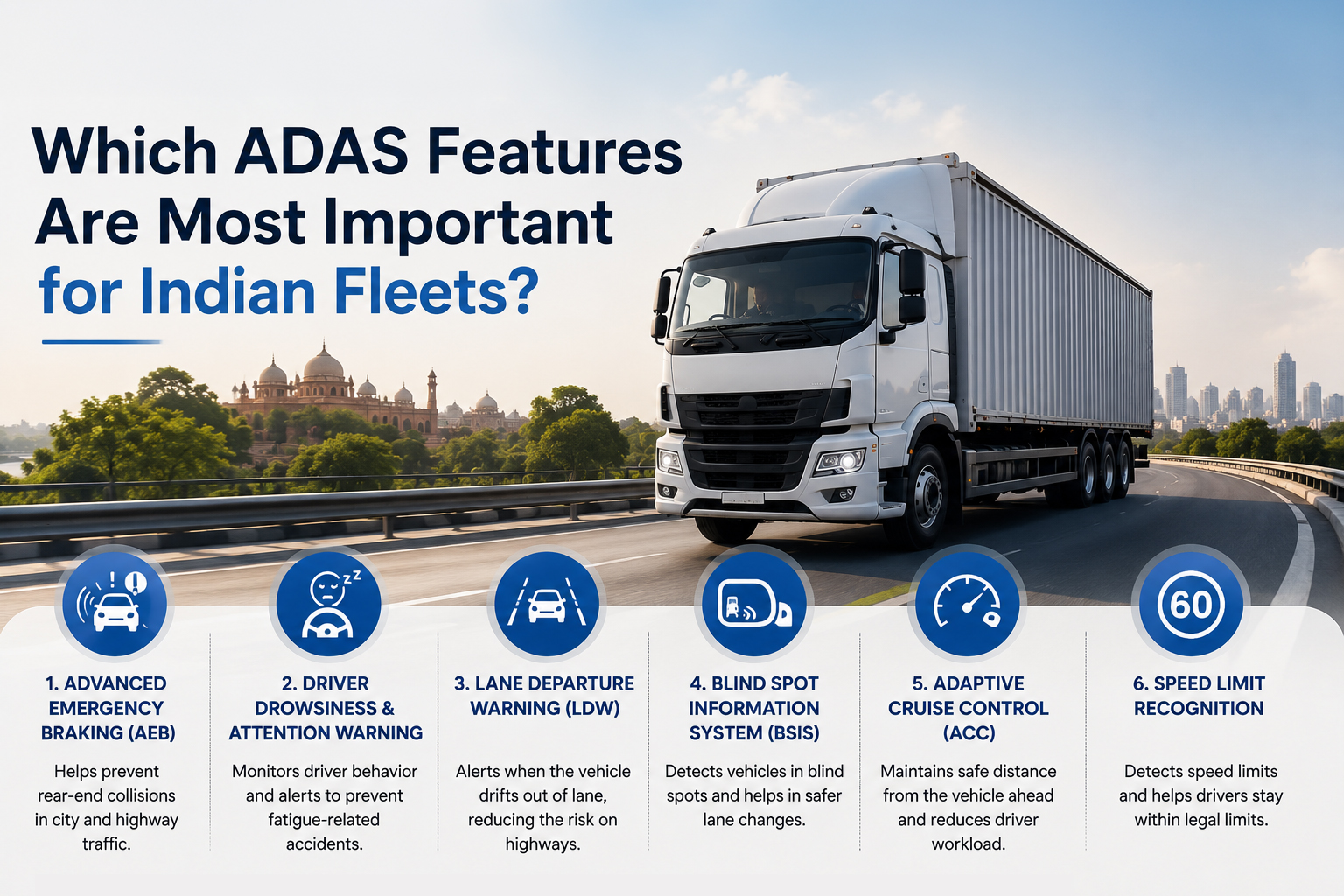
Which ADAS Features Are Most Important for Indian Fleets?
India records a high number of road accidents every year — many linked to driver fatigue, lane drifting, delayed braking, and poor visibility. The most critical ADAS features include:
- Forward Collision Warning (FCW) — alerts drivers when a crash risk is detected
- Automatic Emergency Braking (AEB) — applies brakes automatically to avoid collisions
- Lane Departure Warning (LDW) — warns drivers when vehicles unintentionally leave their lane
These systems rely on automotive sensors, radar technology, cameras, AI-based perception software, and vehicle control units to detect hazards and respond instantly.
FAQs on ADAS for Commercial Vehicles
What is ADAS in trucks?
ADAS (Advanced Driver Assistance Systems) includes lane assist, adaptive cruise, collision warnings, and emergency braking to make driving safer.
Can the solution record incidents automatically?
Yes. Roadcast's system intelligently detects critical events like collisions, harsh braking, or sudden swerves, and automatically records and saves the footage for easy review — ensuring no vital moment is missed.
How can I access the recorded footage?
All footage is securely stored either on the device or in the cloud. Through Roadcast's web portal or mobile app, you can easily access both live feeds and historical video anytime, anywhere.
Is the video telematics solution customizable?
Absolutely. You can tailor the system to your needs — choose specific camera views, set custom alerts for unsafe driving behaviors, and integrate it with your existing fleet management tools for a seamless experience.
What limits the adoption of these technologies in India?
Poor road conditions, unpredictable traffic, and weak regulations slow down the wide adoption of ADAS, platooning, and autonomous trucks.
What is the Cost of Installing ADAS in Commercial Vehicles?
The cost of installing ADAS in commercial vehicles can vary widely depending on the features, brand, and vehicle type. As of 2026, a basic ADAS retrofit kit for commercial vehicles in India typically ranges from ₹25,000 to ₹75,000 per vehicle. Advanced systems with AI dashcams, DMS, and cloud connectivity may cost more. While this is a significant investment, the reduction in accidents, insurance premiums, and downtime can quickly offset the initial cost. For the latest pricing, consult your ADAS provider or fleet technology partner.
Conclusion & Next Steps
The importance of ADAS is evident, with 91% of respondents in a survey by HERE Technologies recognizing it as essential, and 82% willing to invest in ADAS-equipped vehicles. As demand for advanced safety technologies rises, ADAS will become critical to making commercial vehicles a compelling and responsible investment.
The next five years will bring further capabilities that extend what is currently possible:
- Predictive fatigue modelling — shifting from reactive alerts to pre-emptive scheduling of mandatory rest stops before a driver reaches the fatigue threshold.
- Integrated road hazard intelligence — combining dashcam data across a fleet to build a real-time map of road hazards, shared upstream to drivers before their own sensors detect them.
- Insurance integration — operators with demonstrably safer fleets will access preferential commercial vehicle insurance pricing, creating a direct financial return on safety investment.
- V2X connectivity — vehicle-to-everything communication, enabling a level of situational awareness that no onboard sensor system can match independently.
In conclusion, the transformative impact of ADAS on driver behavior and road safety is undeniable. As technology and safety continue to advance together, investing in ADAS now means safer roads, more efficient operations, and a future where preventable accidents become a thing of the past.