Forward Collision Warning Systems Explained: How FCW Saves Lives in Commercial Fleets
Safety is the most important concern of the commercial trucking industry, where large vehicles navigate busy highways and urban streets alongside smaller passenger vehicles. Rear-end collisions are common because even vigilant drivers sometimes lose focus, so automakers have stepped in with a technology that helps warn of approaching danger.
Among these safety-related technologies, forward-collision warning (FCW) systems stand out as a promising tool for preventing collisions and protecting both truck drivers and other road users.
What is a Forward Collision Warning (FCW) System?
A forward collision warning system monitors the vehicle’s speed, the speed of the vehicle in front of it and the distance between the vehicles. If the vehicle gets too close to the vehicle ahead, the system will warn the driver of an impending crash. It’s important to note that forward collision warning systems only warn the driver and do not take action to avoid a crash.
How Does FCW Technology Work in Commercial Trucks? (Step-by-Step)
- Detection: The system continuously scans the area in front of the vehicle for obstacles, including other cars, pedestrians, and stationary objects. This is typically done using cameras and sensors mounted on the car.
- Distance Measurement: FCW systems measure the distance between your vehicle and the detected objects. They assess the relative speeds of your car and the obstacle.
- Risk Assessment: The system evaluates the likelihood of a collision based on distance and relative speed. It triggers a warning if it determines that a collision may occur within a specific time frame.
- Alerts: When a potential collision is imminent, the FCW system alerts the driver. These alerts can be visual (such as dashboard flashing lights) or auditory (such as beeps or alarms), ensuring the driver is aware of the danger.
- Response Time: Early warnings give drivers valuable seconds to react—whether to brake, steer away, or take other evasive actions to prevent a collision.
- Real-time processing: The system’s onboard computer processes data from the sensors and cameras in real time. Using AI and machine learning, the system identifies potential hazards and assesses the likelihood of a collision.
When integrated with ADAS and telematics platforms, they become part of a broader fleet safety technology strategy that helps managers identify risks and coach drivers with more consistent data.
FCW vs. AEB (Automatic Emergency Braking): Key Differences for Fleet Managers
Whilst the Forward Collision Warning (FCW) system only warns the driver of a potential collision, it does not take active control of the vehicle. AEB, on the other hand, goes further by automatically applying the brakes if the driver fails to respond to the FCW alerts, which can prevent or mitigate a crash.
Why Indian Commercial Fleets Need FCW Technology
Commercial fleet accidents in India are primarily driven by a combination of grueling driver fatigue, poor vehicle maintenance, overloading, and systemic industry failures. Of all the causes of trucking accidents, driver error is 10 times more likely to be the cause of a crash than any other factor, according to a recent study conducted by the Federal Motor Carrier Safety Administration (FMCSA).
Crashes involving commercial trucks often result in significant property damage, injuries, and fatalities. Thus, the need for advanced safety technologies, such as FCW, has emerged as a key tool for preventing driver errors.
India's Highway Accident Crisis in Numbers
As stated in a study reported by The Economic Times, India experiences the highest count of road accidents globally, accompanied by a fatality rate of 11%. It is concerning to note that more than 170,000 individuals succumb to road accidents annually, most of which are due to irresponsible driver behavior and can be avoided. 60% of the fatalities occur on highways. Driver fatigue is the single largest contributing factor in highway accidents involving commercial vehicles.
MoRTH Mandates & FCW Compliance
In a direct response to India’s grim road safety statistics, the Ministry of Road Transport and Highways (MoRTH) has mandated the installation of Advanced Driver Assistance Systems (ADAS) for heavy commercial vehicles. The mandate comes into effect on October 1, 2027. From this date, all new heavy trucks and buses sold in the country must be equipped with these active safety features.
While the October 1, 2027, deadline applies to new models introduced after that date, the government has also laid out a roadmap for existing models. Vehicles already in production and on sale will need to be upgraded to meet these norms by April 2028.
The mandate focuses on active safety - systems that intervene before a crash happens rather than just protecting occupants after impact. The Forward Collision Warning system (FCW) can be integrated with ADAS.
5 Key Benefits of Forward Collision Warning Systems for Fleet Operators
- Enhanced Safety: FCW systems help to prevent accidents by alerting drivers to potential collisions, giving them crucial time to react. This can significantly reduce the severity of accidents or avoid them altogether.
- Increased Awareness: It continuously monitors traffic conditions and can detect vehicles or obstacles that a driver might miss, especially in complex driving environments.
- Reduced Driver Fatigue: FCW’s constant monitoring and alerts can alleviate some of the stress associated with driving, particularly in heavy traffic or long trips. This can lead to a more relaxed driving experience.
- Lower Insurance Costs: Vehicles with advanced safety features like FCW may qualify for lower insurance premiums. Insurers often provide discounts for cars with enhanced safety technologies, recognizing their role in reducing accident rates.
- Improved Reaction Time: The early warnings provided by FCW systems enable drivers to respond more quickly to potential hazards, which can be critical in emergencies.
"See how Roadcast's AI dashcam detects forward collision risks in real time”
What to Look for in a Forward Collision Warning (FCW) System
- Comprehensive features: Look for systems that offer multiple types of alerts and automated responses.
- Integration capabilities: Choose a solution that integrates seamlessly with your existing fleet management platform.
- Ease of use: Opt for user-friendly systems that drivers can easily adopt.
- Scalability: Be sure the system can grow with your fleet.
- Vendor support: Partner with a provider that offers robust support and training.
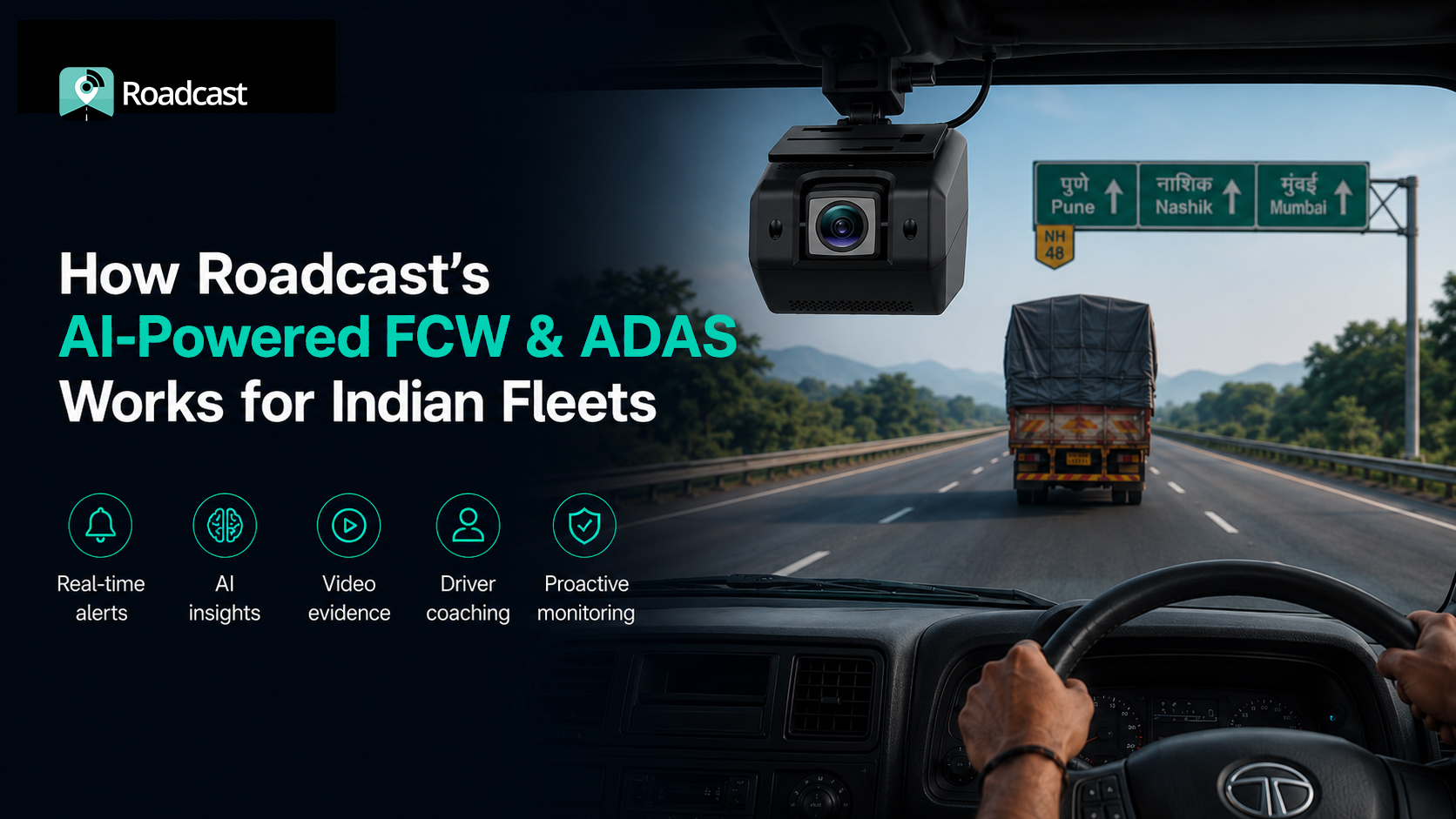
How Roadcast's AI-Powered FCW & ADAS Dashcam Works for Indian Fleets
- Real-time alerts: Drivers receive immediate warnings for unsafe behaviors like tailgating, distracted driving, or harsh braking.
- AI-powered insights: The system uses AI to detect potential hazards and provide actionable feedback to drivers and fleet managers.
- Video evidence: In the event of an incident, high-definition video recordings provide a clear view of what happened, helping fleets defend against false claims.
- Driver coaching: Fleet managers can use recorded footage and analytics to coach drivers to improve their performance and reduce risks.
- Proactive safety monitoring: Motive’s platform provides detailed safety scores, allowing managers to identify high-risk drivers and take corrective actions.
When the AI detects a safety event, the response doesn't stop at the in-cabin alert. It flows through a layered escalation system:
- Layer 1 — In-cabin alert: Immediate audio alert to the driver, fired within milliseconds of event detection by the on-device AI. The driver receives the intervention in real time, not 2 minutes later, when a notification has been processed by a cloud server.
- Layer 2 — Fleet manager notification: The event is simultaneously transmitted to the fleet management platform. The operations control room receives a notification containing the driver's name, vehicle number, location, and event type. A safety manager monitoring 200 vehicles sees a drowsiness alert on Vehicle HR-XYZ near Pune on NH-48 at 2:17 AM and can immediately call the driver.
- Layer 3 — Video clip upload: A short video clip — typically 10 to 15 seconds before and after the event — is saved to the cloud and available for review within minutes. Instead of just an alert, fleet managers can see the driver's full context. This clip-based review model makes monitoring manageable—teams review flagged events rather than hours of continuous footage.
- Layer 4 — Configurable escalation rules: Operators define thresholds that trigger automatic escalation. Three drowsiness events within an hour trigger an automatic supervisor call to the driver. Five events trigger a mandatory pull-over instruction. These rules enforce rest without relying on driver self-reporting or manager availability at 3 AM.
FAQs about Forward Collision Warning for Fleets
What is Forward Collision Warning?
Forward Collision Warning alerts the driver to potential collisions ahead using visual and audible signals. If it senses that the vehicle is approaching an object ahead at a high rate of speed, the warnings will activate.
How does Forward Collision Warning work?
Forward Collision Warning uses radar sensors at the front of the vehicle to calculate distance and speed. If these sensors detect objects close ahead and the vehicle is still at a dangerous speed, it will warn the driver.
What is Forward Collision Warning calibration?
Forward Collision Warning is part of an ADAS system for commercial vehicles. For ADAS systems to operate properly, the sensors and cameras must be calibrated. Calibration is required after any sort of accident or repair.
How effective is Forward Collision Warning?
A study by the Insurance Institute for Highway Safety (IIHS) found that the use of forward-collision warning technology was associated with a 22% decrease in police-reportable crashes (per vehicle miles traveled) for large trucks and a 44% reduction in the rate of rear-end crashes. Further, FCW systems can reduce front-to-rear collisions by 27%.
What is a Forward Collision Warning System in commercial vehicles?
Forward Collision Warning (FCW) detects vehicles or obstacles ahead using millimeter-wave radar. The system calculates the distance to the object in front and, if the car gets close enough to pose a collision risk, sounds an alarm and displays a visual alert, prompting the driver to apply the brakes.
How does FCW technology prevent truck and bus accidents?
Statistics show that many collisions result from delayed human reaction times; hence, the primary importance of FCW lies in its ability to prevent accidents. FCW addresses this issue by providing timely alerts.
Is Forward Collision Warning mandatory in India for commercial fleets?
As of 2026, Forward Collision Warning is not mandatory in India.
How accurate are FCW dashcam systems in Indian road conditions?
Unlike highly structured Western driving environments, Indian roads present a completely different challenge:
- High-density, mixed traffic (cars, trucks, two-wheelers, pedestrians, animals)
- Overloading
- Poor lighting in many areas
- Frequent exposure to dust, fog, rain, and glare
- Poor quality of road surfaces (other than on major highways)
- Vulnerabilities such as larger blind spots and longer stopping distances, especially in congested urban areas and highways.
In such conditions, Forward Collision Warning (FCW) systems do work in India, but their accuracy is lower than in Western countries. It works very well on Highways and fleet corridors; it works moderately on city arterial roads, dense traffic, and mixed traffic.
Market Growth
The forward collision warning system for the automotive market has grown rapidly in recent years. It will grow from $37.42 billion in 2025 to $41.69 billion in 2026 at a compound annual growth rate (CAGR) of 11.4%. It will grow to $64.12 billion in 2030. The growth in the forecast period can be attributed to rising road accident rates, increasing consumer awareness of vehicle safety, mandatory ADAS regulations, the growth of autonomous and semi-autonomous vehicles, declining sensor and computing costs, the expansion of electric vehicle production, and greater integration with connected vehicle platforms and advancements in radar and camera technologies.
Conclusion
With the increasing number of vehicles on the roads, enterprises are looking for cutting-edge safety solutions. Forward Collision Warning (FCW) systems have revolutionized automotive safety. This cutting-edge technology is designed to prevent accidents by providing advanced warning of potential collisions. Collision avoidance systems are essential for improving driver safety, reducing accidents, and improving fleet efficiency. At Roadcast, we’re committed to helping fleets stay safe with cutting-edge safety solutions.
Ready to make your fleet MoRTH ADAS-compliant before 2027?
Talk to a Roadcast fleet safety expert.