
Introduction
Telematics: Fast Tracking India's Next-Gen Logistics
The Road Transport Ministry has mandated, that effective October 2027, all new models of trucks and buses, including school buses will need to have ADAS (Advanced Driver Alert System). Similarly, for existing models of trucks and buses, the mandate is effective from January 2028. What led the Govt. to implement these radical measures? Disturbing statistics on road deaths in India. Shockingly, Govt data shows, that in 2024, number of road fatalities was over 1.70 lakh people, with 60% of the fatalities on highways!
This has led safety today to transition from reacting to incidents, to preventing them altogether. It is at the core of fleet management solutions. With rising accident rates and associated prohibitive costs, like insurance premiums, fleet managers can no longer afford reactive safety strategies. They need intelligent, proactive solutions that help drivers prevent accidents before they happen. The future of fleet safety lies in AI-powered video telematics systems that not only capture events but also analyze risk in real-time, coach drivers, and provide actionable insights.
Since real-time visibility remains elusive, fleet owners and managers need data insights. The deployment of a superior telematics management system can be vital for fleet management, enabling safety, operational efficiency and vehicle maintenance. Fleet operators will be able to aggregate a vast amount of data from geographical locations and usage patterns.
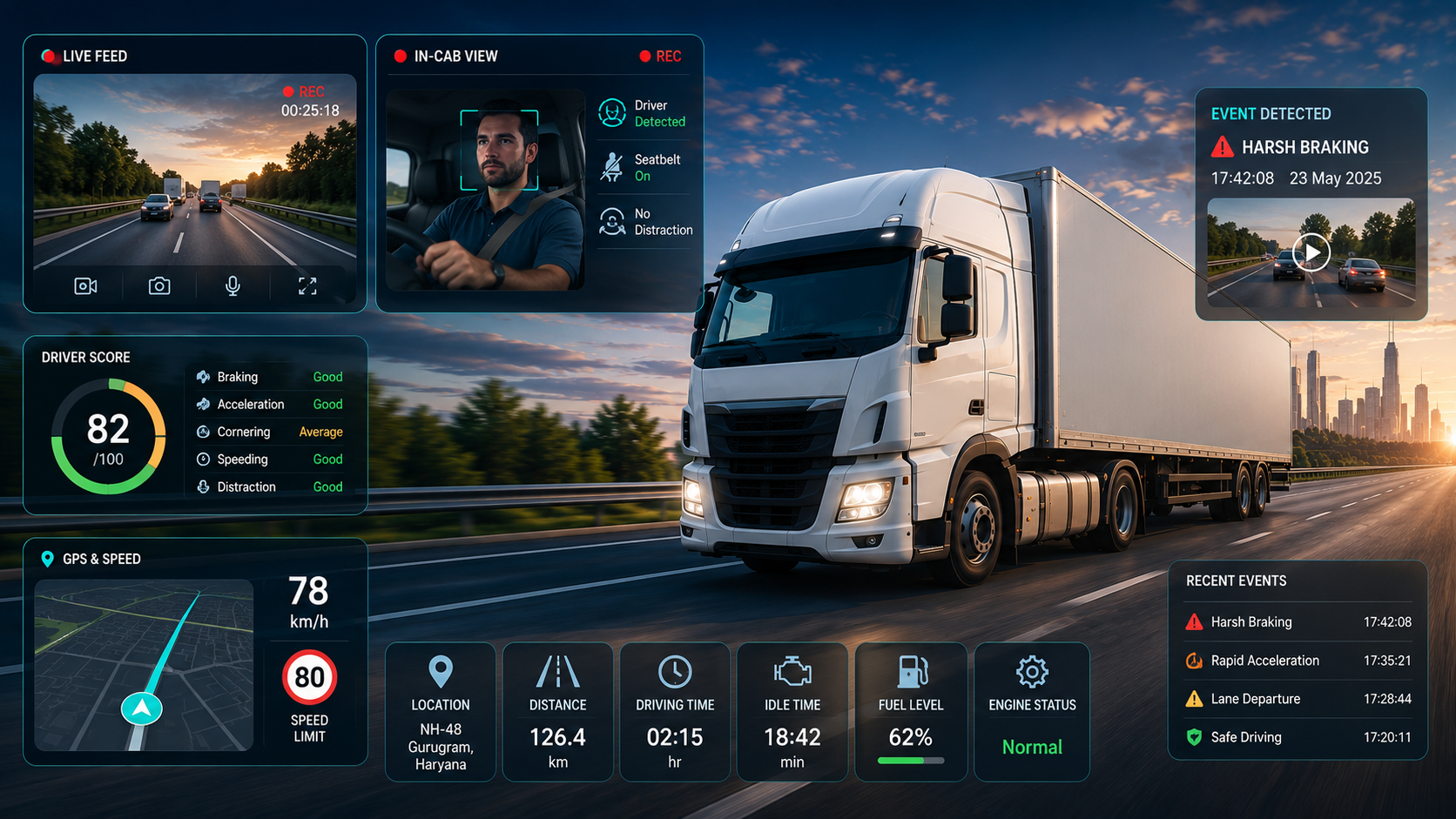
What Is Video Telematics?
Telematics is a combination of the words “telecom” and “informatics.” Telecom means transmitting data over a cellular network or satellite in real-time. And informatics is how you process and store that data.
Telematics is a method of monitoring vehicles, equipment and other assets using GPS technology and on-board diagnostics (OBD) to plot the asset movements on a computerized map.
To track assets, information from the vehicle is recorded via a small telematics device — also called a black box — that plugs into the OBD II or CAN-BUS port. A SIM card and modem in the device enable communication on the cellular network. In addition to the hardware, the algorithm used for GPS logging is another critical factor because it impacts the quality and accuracy of the data.
How Video Telematics Works: GPS, Sensors, AI & Cloud Analytics
A telematics device utilizes GPS for location tracking, sensors for data collection (speed, diagnostics), and cellular networks for data transmission. A central system receives the information, whereby a fleet manager can monitor in real-time and analyze performance.
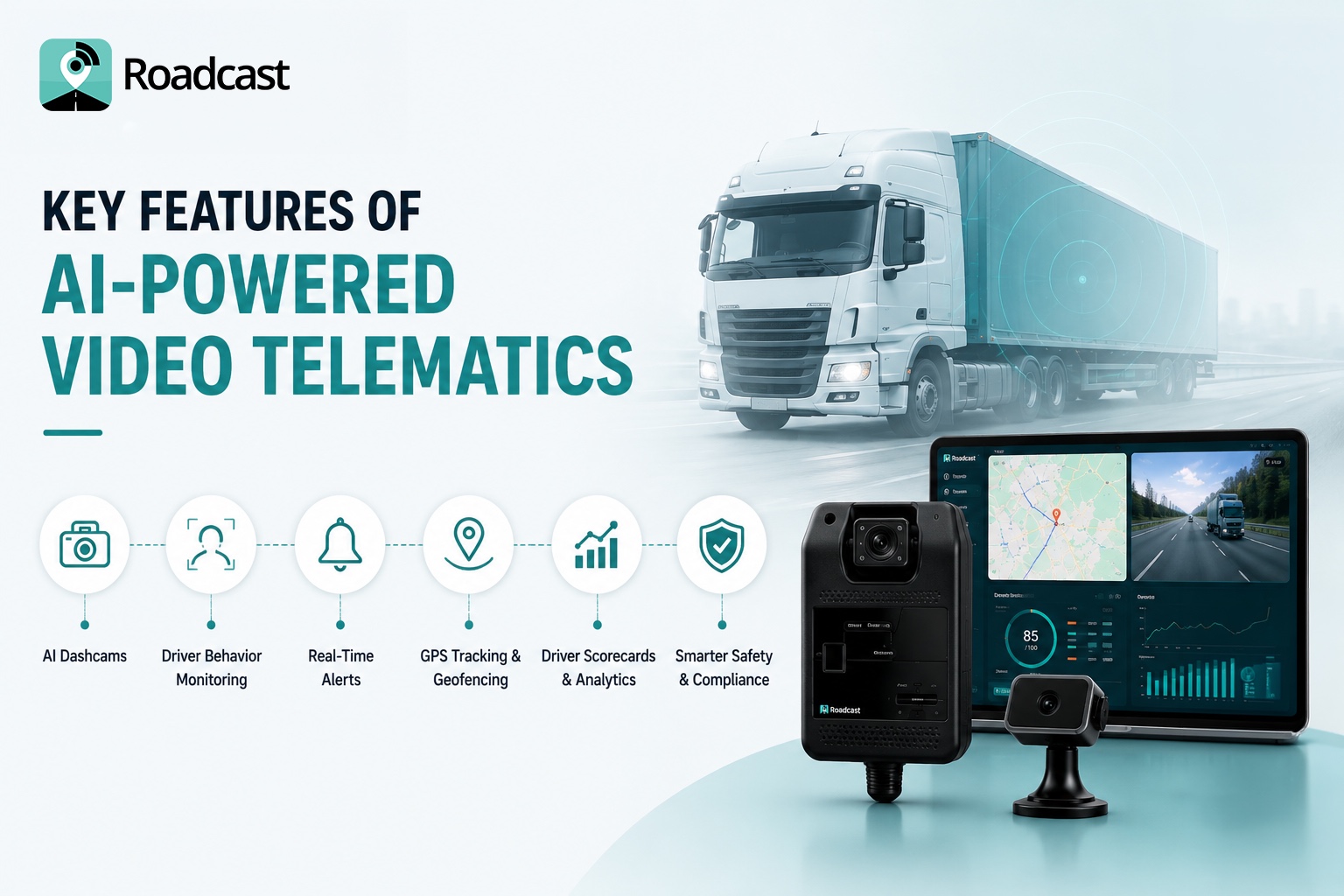
Key features of the telematics system.
- Sensors and Data Gathering
Telematics device units are fitted with various carefully positioned sensors which keep an eye on several different characteristics, including Speed, Accumulation and Deceleration, Braking Patterns and Engine diagnostics.
These sensors collect data continually while the vehicle is being driven, giving a complete picture of the driver's style and vehicle state. - GPS Technology
The Global Positioning System (GPS) is essential to telematics because it precisely determines the vehicle's location, real-time. Coordinates for latitude, longitude, and altitude are obtained via satellite communication between the telematics device and satellites' GPS receivers. - Data Storage: Centralized Storage and Analysis
The command centre has become a sophisticated edge-computing hub that integrates AI vision, vehicle telemetry, and cloud analytics to protect assets and lives. It integrates with dashcams to provide real-time monitoring and proactive response. It receives live video feeds, alerts, and incident reports from dashcams installed in vehicles. It enables scalability to accommodate expanding fleets and growing data volumes.
Recent operational data is temporarily stored in a vehicle's telematics device before being transmitted to centralized systems. This provisional storage guarantees data continuity during connectivity failures and enables smooth data transfer when communication is restored. - Data Transmission
Telematics data transmission uses networks like GPRS, 4G, or satellite to transfer real-time vehicle data, such as position, speed, and diagnostics, from onboard equipment to centralized computers.
Data integrity and confidentiality are ensured during transmission through secure communication protocols, which is crucial for compliance and operational effectiveness in all sectors of the economy that depend on fleet management and logistics. - Data Analysis
Through advanced machine learning and predictive services, complex algorithms process and analyze the data, transforming it into actionable insights. Additionally, cybersecurity measures are implemented to ensure the integrity and security of the vehicle information. - Alerts and Notifications
Based on the analysis, the telematics system can generate real-time alerts and notifications for fleet managers, drivers, or maintenance personnel. For example, if the system detects a driver dozing off behind the wheel, it can immediately notify the relevant parties. - Historical Data Tracking
One advantage of Telematics systems that it provides a historical record of vehicle data. Fleet managers can track trends and analyze long-term performance. It can assist in proactive maintenance planning.
11 Key Features of AI-Powered Video Telematics Systems
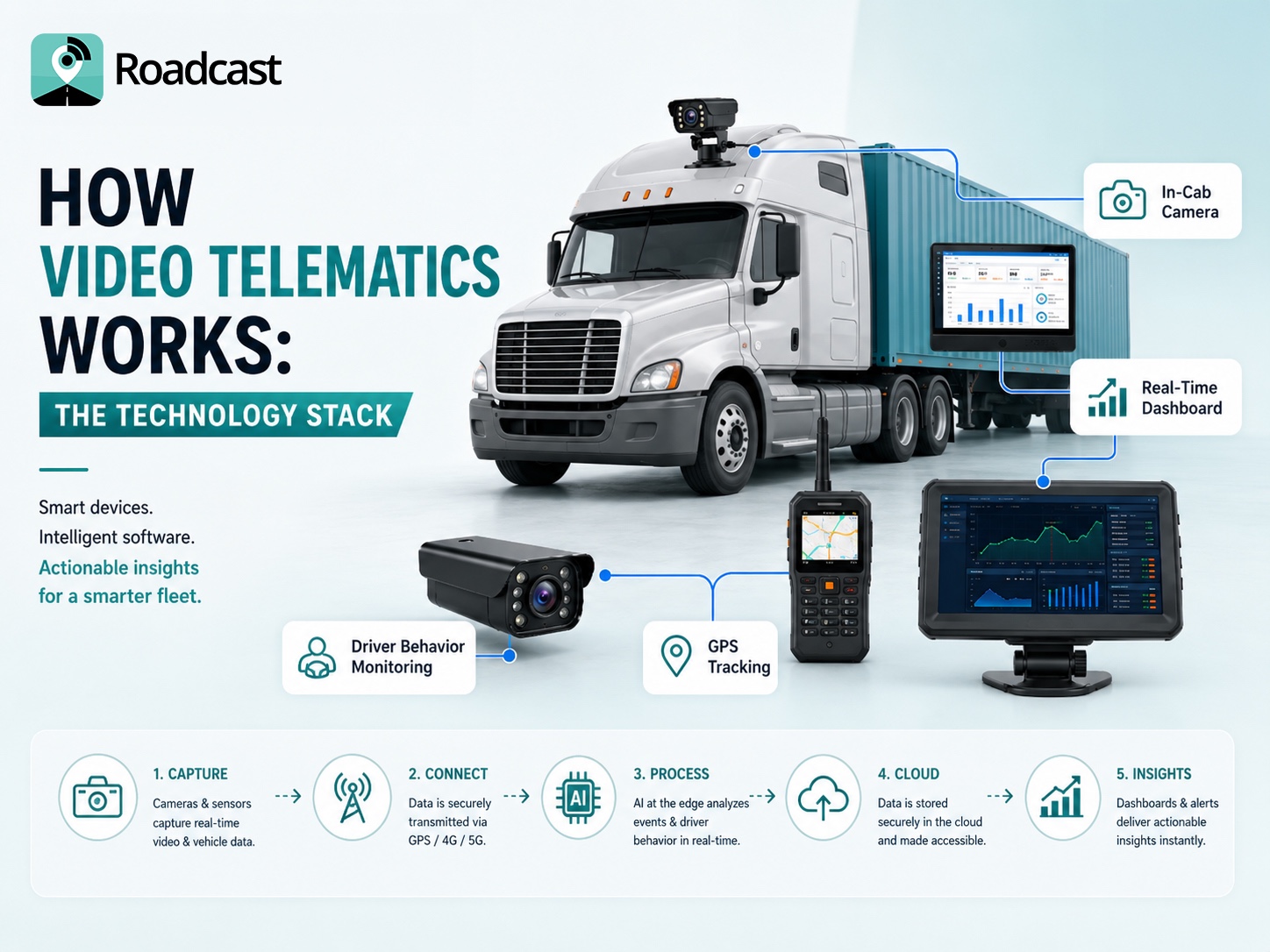
The relevance of fleet video telematics systems grows every day as logistics networks expand, regulatory pressure increases and customer expectations sharpen.
- Real-Time Driver Monitoring
AI continuously monitors driver behavior inside the cabin and detects risks such as Fatigue / yawning, Distracted driving, Mobile phone usage, Smoking, No driver in frame and Seatbelt violations
This helps fleets correct unsafe behavior before it leads to an incident. - Advanced Road-Facing Intelligence
The outward-facing camera and AI models monitor road conditions and detect Forward collision risks, Lane departure, Unsafe following distance, Pedestrian collision warnings, Harsh braking and sudden acceleration and Rash driving patterns.
This gives fleets visibility into both driver actions and external road risks. - Instant In-Cab Alerts
When risky behavior or dangerous road conditions are detected, the system can trigger Voice alerts and Real-time driver notifications. For e.g., in case drivers get tired due to excessive driving, an alarm will ring within the vehicle. Drivers can decide to rest before continuing to avoid risks.
This enables immediate corrective action instead of post-incident review. - Live Video Streaming
Fleet managers can access live video feeds from vehicles for Active trip monitoring, Emergency response, Incident verification and High-value asset supervision.
This is especially useful for critical fleets, school transport, logistics, and high-risk operations. - Event-Based Video Recording
Instead of reviewing hours of footage, the system automatically captures and stores clips linked to specific events such as accidents, route deviations and drivers’ misdemeanors.
This makes investigations faster and more efficient. - GPS Tracking with Video Context
AI-powered fleet video telematics system combines video with telematics data to give a complete picture of what happened, where it happened, and why it happened by capturing Live location, Speed, Route history and other details. - Driver Safety Scoring
The platform can convert driver behavior into performance metrics like Safety score and Violation trends.
This helps managers identify high-risk drivers and run targeted coaching programs. - Incident Management & Evidence Storage
All critical events can be logged into a central platform with Timestamped video evidence, Photos and clips and incident history. For e.g. Drivers are valuable assets to the fleet. They can’t be blamed for accidents they aren’t responsible for.
This supports compliance, internal review, and insurance claims. - Cloud-Based Fleet Dashboard
Fleet owners may access all improved diagnostics data from a single dashboard, which is often only available at their dealer. This gives them complete control over how their fleet is operating. The telematics platform enables fleet managers to control their fleets from a computer or a smartphone app and communicate with drivers in real-time.
This creates a single command center for fleet visibility. - Tamper & Security Detection
The system can detect operational and device-related risks such as Camera obstruction, Power cut, Device removal and Tampering attempts
This ensures system reliability and improves trust in captured evidence. - Multi-Camera Support
Many deployments support multiple camera views, i.e. 360 degrees
This is useful for fleets that need wider operational visibility.
Top Benefits for Fleet Operators in India
Reducing accidents.
Engaging with phones, speeding, tailgating, illegal overtaking, falling asleep and many other risky driver behaviors could lead to accidents. Video telematics systems constantly monitor driving behavior. When they detect unsafe actions, AI-enabled systems may automatically provide audio alerts, visual signals, or vibrations. This prompt feedback helps drivers correct their behavior on the spot, minimizing the occurrence of serious accidents.
Promoting a culture of safe driving.
Companies that proactively invest in video telematics systems, send a clear message about their commitment to safety, which motivates drivers to adopt a more cautious and responsible driving attitude.
Also, the footage captured by video telematics systems is great for further training. Drivers can review footage of themselves or other drivers and see exactly what not to do. This helps them understand the real consequences of unsafe driving and promotes better habits on the road.
Fostering driver satisfaction.
Video telematics has evolved from preventing accidents to supporting drivers through scorecards evaluation and recognition programs. By using video in these programs, the evaluation process becomes transparent and fair. This approach enhances job satisfaction because drivers know they’re being assessed accurately and rewarded for good performance, which also motivates them to avoid risky behavior and continually improve their skills.
Reducing operational costs. Adopting safer driving habits through video telematics not only leads to fewer fines but also lowers other significant expenses such as vehicle maintenance costs and insurance premiums.
Besides, if an accident occurs, video evidence can clarify the situation, potentially exonerating the driver and the fleet owner from fault. This can help avoid costly legal disputes and settlements, thereby protecting the company’s financial interests.
Сompliance with local laws.
Regulatory compliance is a major concern for fleet managers in many countries. Video telematics can help fleet owners mitigate risks and avoid fines and other penalties for non-compliance.
Customer service improvement.
Real-time updates for customers help in improving customer service. Video telematics aids in precise incident reporting and quality control during transit. It also means more transparency for businesses, as customer service teams manage expectations better. Overall, this boosts customer satisfaction and builds trust.
The ROI of Video Telematics: How Enterprises Cut Costs and Risk
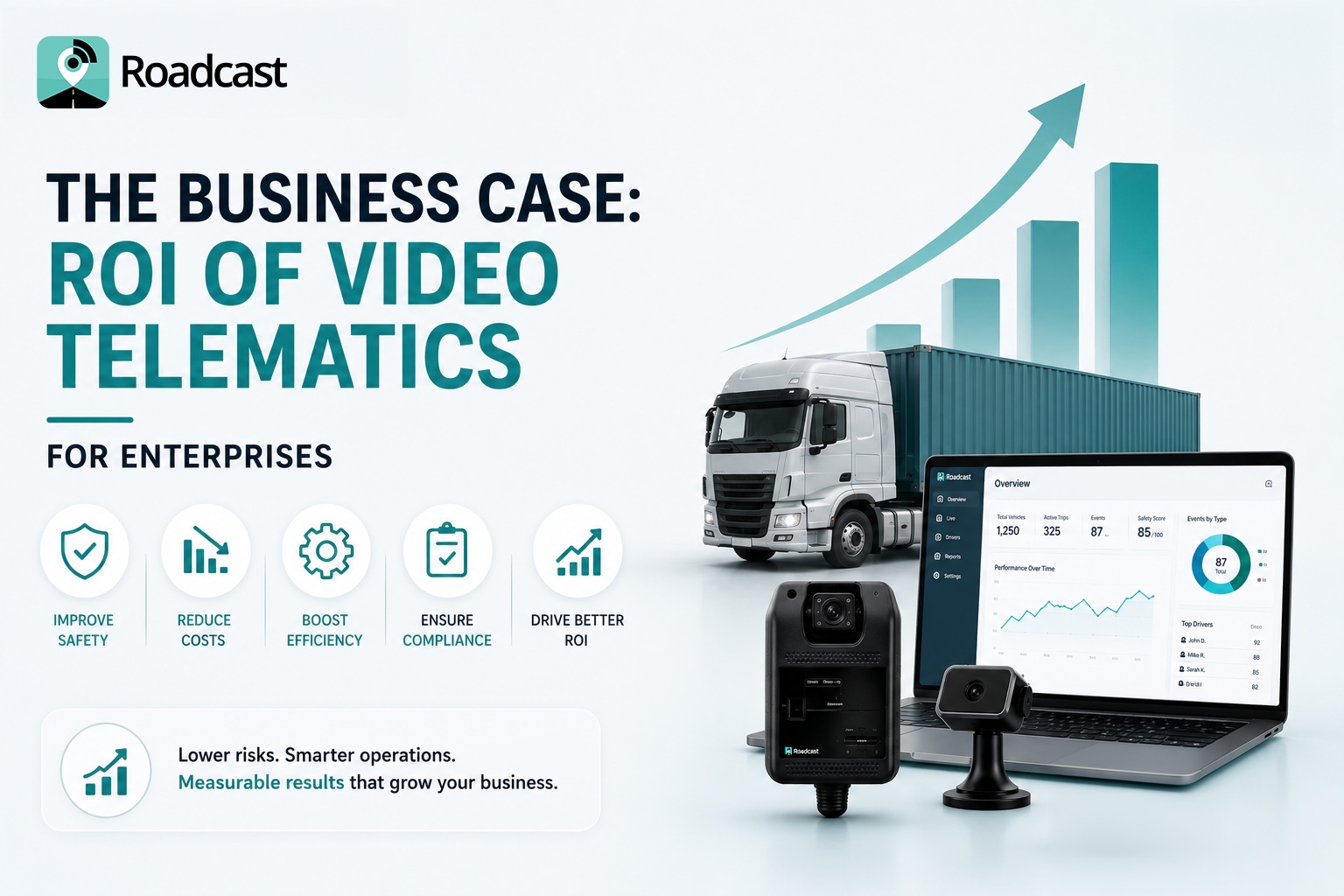
With increased competition and rising cost pressures, fleet owners and managers need data insights to drive efficiencies in their fleet operations. Here are some ways in which telematics solutions can improve the profitability of a fleet’s operation.
- Saving Fuel Cost
Fuel cost typically comprises 40% to 60% of a fleet’s operating cost. The two key factors that can help to control fuel costs are driving behaviour and proper vehicle maintenance. Driving at optimal speed can save up to 10% of the fuel cost. Telematics-based fleet management dashboards help fleet managers identify fuel savings opportunities, take necessary action, and measure the impact of these actions. - Identifying the "silent fuel killer"
Excessive idling is one of the most overlooked sources of fleet waste. And, excessive engine idling can not only increase fuel consumption but also cause a buildup of carbon residue in a truck’s engine, which can damage engine components, including spark plugs and exhaust systems, increasing maintenance costs and shortening the lifespan of the engine. AI and data analytics add the critical context of why a vehicle might be idling for too long.
This level of verification allows managers to take targeted action, reducing fuel consumption without disrupting operations. - Reduce Downtime with Preventive Maintenance
Unforeseen downtime is a major cause for loss of business to fleet companies, in addition to consuming the bandwidth of fleet managers. Maintaining vehicles in good condition is a key goal for all fleet managers and preventive maintenance plays an important role in this regard.
Although regular maintenance is a common practice, taking action on vehicle issues at the right time is ignored due to a lack of information on issues. That is where OBD based Telematics solutions can provide timely diagnostic alerts and predictive maintenance suggestions. - Reduce Accidents by encouraging Safe Driving
Accidents caused by risky driving lead to major losses for fleet companies with enormous repair costs, vehicle downtime, legal costs and, loss of insurance benefits. Analyse drivers' driving patterns using certain quantitative measures such as Safe Driving Score. With personalized guidance, drivers can be progressively coached to become safer drivers. Better driver behavior leads to lower accident frequency, improved fuel efficiency, less wear and tear, and a more disciplined fleet. - Protection Against Fraud and False Claims
In many fleet operations, businesses lose money due to False accident claims, Misreported driver events, Disputed liability and Theft or tampering-related uncertainty. Video evidence adds context that raw GPS data alone cannot provide. Enterprises avoid unnecessary payouts and reduce revenue leakage caused by poor visibility. - Faster Incident Resolution
With incidents being recorded as video clips, enterprises can review incidents quickly. Faster incident closure means lower admin effort, quicker decision-making, faster vehicle recovery, and reduced operational disruption. - Lower Insurance Burden
Video telematics for fleet insurance claims helps by providing clear visual proof during disputes and supports faster claim validation. Better evidence and lower risk profile can reduce claim leakage and strengthen insurance negotiations, thus aid in reduced premiums. - Use Geofencing for Effective Location Monitoring
Appropriate geo-fence and other location-based alerts with real-time notifications can assist fleet managers in tracking all key vehicle movements. Additional features such as sharing vehicle location on demand with customers can further boost productivity of the fleet managers. - Improve Fleet Utilisation through Route Planning and Optimization
For Fleet operations involving daily vehicle assignment and route scheduling, an automated route optimization solution can help minimize the number of vehicles needed and overall travel distance/ time for completing the same number of tasks. It can increase operating profitability if the fleet company is paid per delivery operation or per pick-up/drop. It can also provide the end customer with information on the expected arrival time, thereby increasing customer satisfaction. Automatic detection of Route Deviation can help fleet managers keep tabs on unauthorized detours and misuse of vehicles. - Stronger Compliance and Audit Readiness
For many enterprises, especially in logistics, employee transport, construction, mining, and school transport, compliance is critical. Video telematics supports Safety policy enforcement, Driver accountability, Evidence-backed investigations, Audit documentation and Incident traceability. Unnecessary costs can be averted with reduced compliance risk, better governance, and stronger defensibility in legal or regulatory situations. - Safeguard Your Cargo
Fleet telematics can help prevent the theft of cargo from trucks and the theft of loaded trucks and trailers. Door open/close sensors for trailers alert drivers and/or managers when a door is opened, which can tip them off to a theft in progress. Asset tracking tags affixed to cartons, packages and pallets and paired with a telematics gateway device on the trailer can send an alert when an item is removed from the radius of the device. Ignition on/off alerts and geofence alerts can tip off drivers and managers to unauthorized usage of the vehicle, outside of designated operating hours
Video Telematics vs GPS Tracking
The two technological terms i.e. GPS Tracking and Telematics are very similar but can have different contexts when it comes to the collection of different types of data. While both of these technological advancements involve monitoring location or valuable insights, they offer distinct functionalities and benefits.
GPS tracking refers to the process of utilizing the Global Positioning System (GPS) to determine the precise location of an object, person, or asset in real-time. It involves the use of GPS technology, which relies on a network of satellites orbiting the Earth to accurately pinpoint the location of a GPS receiver or a device.
Telematics refers to the technology that combines telecommunications and informatics to send, receive, and store information related to the vehicle over a network. This then processes and analyzes that data for various purposes such as tracking, monitoring, and managing assets, optimizing vehicle performance, providing navigation assistance, and facilitating communication between vehicle and external systems.
| Dimension | GPS Tracking | Telematics |
|---|---|---|
| Core Purpose | Track vehicle location | Enable end-to-end vehicle, driver, and asset intelligence |
| Primary Data Captured | Location, speed, route history | Location + engine data, driver behavior, video, sensors, diagnostics |
| Hardware Complexity | Basic GPS device | Integrated hardware: TCU, sensors, cameras, CAN/ECU interfaces |
| Real-Time Visibility | Limited to position updates | Real-time visibility into vehicle, driver, cargo, and environment |
| Driver Behavior Monitoring | Minimal or none | Comprehensive (harsh braking, fatigue, distraction, overspeeding) |
| Video & Vision Support | Not supported | Supported (in-cab, road-facing, ADAS, DMS) |
| Maintenance & Diagnostics | Not available | Predictive and preventive maintenance using engine and usage data |
| Safety & Risk Management | Reactive (post-incident tracking) | Proactive (real-time alerts, incident prevention, coaching) |
| Integration Capability | Standalone system | Integrates with ERP, TMS, WMS, BI, insurance, and fuel monitoring systems |
| Compliance & Audit Trails | Limited proof | Detailed, timestamped, regulation-ready data trails |
| Scalability | Suitable for small fleets | Designed for large, complex, multi-location fleets |
| Typical Use Case | Basic tracking, theft recovery | Safety, efficiency, compliance, and business intelligence |
Compliance and Regulatory Benefits
Telematics creates a digital trail of vehicle activity, driver behavior, trip movement, and operational events, thus it turns compliance from manual into real-time operational proof. When telematics is paired with video, GPS, and event logs, enterprises get timestamped evidence for accidents, unsafe driving, route deviations, tampering, and response timelines. That makes compliance easier to prove, monitor, and improve.
Telematics helps organizations enforce internal safety rules and align more closely with external safety expectations by tracking risky behaviors such as speeding, harsh braking, distraction-related events.
Because telematics centralizes data in a platform, fleets can produce reports faster for compliance teams, customers, insurers, or authorities.
Industry Use Cases in India
Logistics & Transportation
For FMCG fleets telematics systems improve route discipline, reduce turnaround time at delivery points, and provide visibility into idle time and stoppages. Geofencing and trip analytics help ensure delivery compliance, improve replenishment cycles, and strengthen distributor accountability.
FMCG & Retail Distribution
FMCG fleets run multiple short-haul trips daily, often through distributor-managed vehicles. Telematics systems improve route discipline, reduce turnaround time at delivery points, and provide visibility into idle time and stoppages. Geofencing and trip analytics help ensure delivery compliance, improve replenishment cycles, and strengthen distributor accountability.
Oil & Gas
For Oil & gas operations telematics plays a critical role in monitoring driver behavior, overspeeding, route adherence, and unsafe maneuvers. Integrated video, geofencing, and sensor data create a robust audit trail, reduce incident rates, and improve workforce safety across upstream, midstream, and downstream operations.
Cold Chain & Pharmaceuticals
In cold-chain logistics, video telematics software integrates GPS tracking fleet safety and compliance with temperature and door sensors to ensure end-to-end visibility of cargo conditions, because even minor temperature variations can lead to product spoilage or regulatory violations. Real-time alerts allow immediate corrective action, reduce wastage, ensure compliance, and preserve product integrity throughout transit.
Mining & Construction
Mining and construction fleets rely on high-value, heavy equipment operating in rugged environments. Telematics devices monitor equipment’s health, utilization, and location while preventing unauthorized usage through geofencing. Predictive maintenance insights help reduce downtime, improve asset productivity, and optimize capital investments across project lifecycles.
Manufacturing & In-Plant Logistics
Within manufacturing plants, telematics supports visibility into yard movements, material transport vehicles, and dwell times. By tracking in-plant vehicles and integrating with production systems, organizations can identify bottlenecks, reduce congestion, and maintain takt-time stability. This transforms in-plant logistics from a reactive function into a digitally controlled flow system.
Cash Logistics & High-Value Transport
Cash-in-transit and high-value cargo movements demand the highest levels of security. AI-powered video telematics solution transport and logistics combines multi-camera systems, panic alerts, route locking, and real-time monitoring to detect anomalies instantly. This reduces theft risk, enables faster incident response, and strengthens compliance with stringent security protocols.
How to Choose the Right Video Telematics Platform
Choose the platform that turns video into visibility, visibility into action, and action into measurable fleet improvement.
- Define clear objectives
- Ensure hardware robustness
- Prioritize analytics and alerting
- Plan for integration
- Acceptance of change by management and key stakeholders.
How Enterprises Roll Out Video Telematics
A successful video telematics rollout is not just a hardware installation project. It is a cross-functional implementation involving operations, safety, IT, fleet teams, and drivers.
- Define the objective
Enterprises start by identifying the problem and desired outcome before rollout, because that shapes configuration, access levels, reporting, and change management. - Build a cross-functional rollout team
A proper rollout usually includes operations, transport, safety, compliance, IT, procurement, and regional managers. Successful implementation depends on engagement from all levels of management. - Define the operational rules
Before installation begins, enterprises should define which assets are to be included, which camera views are required, how live video is to be monitored and by whom. What will be the response time when a risky behavior is detected. - Start with a controlled pilot
Most enterprise rollouts begin with a pilot rather than a fleet-wide deployment. A pilot might cover one branch, one business unit, one route type, or a carefully selected vehicle group. The goal is to test installation quality, alert relevance, driver reaction, data accuracy, and reporting workflows before scaling. - Standardize installation and calibration
Once the pilot design is set, enterprises need a repeatable installation model. Professional installation reduces downtime, improves consistency, and supports faster ROI. In other words, installation quality directly affects data quality and long-term trust in the system. - Prepare drivers and supervisors before launch
Enterprises that roll out telematics well usually communicate to all levels, explain why the platform is being introduced, how the data will be used, what behaviors are being monitored, and how the program benefits both safety and fairness. - Train teams by role
Different users need different training. Drivers need to understand alerts and behavior expectations. Supervisors need to know how to review incidents and coach fairly. Admins need to configure rules, groups, users, and reports. Fleet managers need to track trends and measure outcomes. - Go live in phases
A phased rollout reduces operational disruption and gives the team time to fix installation issues, refine alert thresholds, and support each location properly. - Measure the rollout with clear success metrics
The rollout should be tracked with defined KPIs from day one. - Move from deployment to continuous improvement
A rollout is only the beginning. After deployment, enterprises constantly review achievements.
Common Challenges and How to Overcome Them
Video telematics often face predictable challenges. Enterprises that anticipate and structure around these issues see faster ROI and better adoption.
- Driver Resistance & Privacy Concerns
Drivers may feel constantly monitored, leading to resistance, distrust, or even attempts to disable the system. This happens because there is lack of clarity on purpose. The drivers fear punitive action and believe their personal privacy is being compromised.
The Enterprise should communicate clearly the whole purpose of the technology is safety and, not surveillance. Policies should be transparent i.e. what is monitored, when, and why. Data should be used for coaching, not punishment. Enable privacy controls (e.g., no recording during off-duty where applicable)
Once the drivers see value in the technology and their confidence is gained, there will be higher acceptance. - Poor Installation & Hardware Reliability
Poor calibration leads to wrong alerts, missed events and low trust in the system
Enterprises need to standardize installation SOPs and use certified installers. Further they need to run post-install QA checks, also validating camera angles and calibration - Too Many Alerts (Alert Fatigue)
Excessive or irrelevant alerts overwhelm drivers and managers, leading to ignored warnings, reduced effectiveness and monitoring fatigue.
Use intelligent filtering and grouping by prioritizing high-risk events (fatigue, collision risk) - Lack of Actionable Insights
Many systems generate data but fail to convert it into decisions due to too many raw clips, no prioritization or Limited analytics
Enterprises should implement driver scoring models, use dashboards with trends and rankings, highlight repeat offenders and high-risk patterns. Also focus on insights, not just events - Integration Gaps
Video telematics operates in a silo, independent from other systems like GPS tracking, Fuel systems, Trip and driver management. This creates fragmented workflows.
The solution is to choose a unified platform wherein video is integrated with telematics data. Also cross-module visibility should be ensured - Bandwidth & Connectivity Limitations
Continuous video streaming is bandwidth-heavy. The challenges faced are network issues in remote areas, delayed uploads and high data costs.
To overcome the challenges, Enterprises should use edge AI (process on device) and upload only event-based clips. Enable offline storage and optimize video compression. - Weak Adoption by Operations Teams
Even after deployment, teams may not actively use the platform.
Define clear ownership (who monitors what) and set daily/weekly review routines. Train teams role-wise (ops, safety, admin) and tie usage to KPIs - Difficulty in Measuring ROI
Enterprises struggle to quantify benefits.
Define baseline metrics before rollout, track violations and incident resolution time. Build simple ROI dashboards - Data Overload & Storage Management
Video generates large volumes of data which leads to storage costs, difficulty in retrieval and compliance concerns
Use event-based storage instead of continuous recording and define retention policies.
Video telematics doesn’t fail because of technology—it fails when data is not trusted, not used, or not acted upon.
The Future of Video Telematics in India
The global telematics market is valued at more than INR 683,800 Crs ($88 Bn) and is growing at a CAGR of 18% in 2026. The Indian Telematics market accounts for around 0.08% of the worldwide market and is valued at INR 555 Crs this year. A study by Deloitte highlighted that 80% of Indian buyers prefer vehicle connectivity; this number is significantly higher than consumers in other countries. The Commercial Telematics Market in India is expected to be USD 2.37 billion by 2027, growing at a CAGR of 15.6%.
The telematics landscape is entering a high-growth phase, driven by 5G connectivity and the gradual emergence of autonomous vehicles. As data volumes increase, maintaining strict privacy and regulatory compliance will be as critical as advancing technology itself, given the sensitive nature of driver behavior and vehicle data.
Processing data at the edge (on-vehicle) enables ultra-low latency alerts and decisions, e.g., immediate reaction when a driver deviates, or a collision risk emerges. Combined with AI-driven analytics, telematics is evolving from monitoring to real-time intervention.
A key shift is the move toward edge computing. Processing data directly on the vehicle enables ultra-low latency decisions such as instant alerts for collision risks, driver distraction, or unsafe deviations. This transforms telematics from passive monitoring into active, real-time intervention systems.
Future platforms will also integrate video with external data sources - such as weather, road conditions, and even driver health metrics providing a comprehensive operational view.
As autonomy advances, video telematics will remain essential for safety validation, situational awareness, and performance monitoring. Overall, telematics is transitioning into an intelligent, connected, and predictive layer at the core of modern fleet operations.
Related Blogs
Video Telematics for Enterprise Fleets: Safety, Compliance & Data-Driven Insights
Transportation of E-Goods: Problems and Solutions
FAQS
What is video telematics in fleet management?
Telecom means transmitting data over a cellular network or satellite in real-time. And informatics is how you process and store that data.
Telematics is a method of monitoring vehicles, equipment and other assets using GPS technology and on-board diagnostics (OBD) to plot the asset movements on a computerized map.
How does video telematics improve fleet safety?
Video telematics systems constantly monitor driving behavior. When they detect unsafe actions, AI-enabled systems automatically provide alerts. This prompt feedback helps drivers correct their behavior on the spot, minimizing the occurrence of serious accidents.
Can video telematics help with insurance claims?
When the fleet is monitored well and every unsafe driving event is visually recorded through dashcams-supported telematics software, reconstruction of accidents becomes possible. It provides clear evidence of who was at fault, which prevents unnecessary litigation (if things escalate). In fact, insurance providers price their premiums less for fleets that operate with less risky driving profiles and have AI dashcams attached to their vehicles.
How does video telematics support compliance?
Telematics helps enterprises move from manual compliance to continuous, data-backed compliance.Instead of relying only on paper logs, verbal reporting, or after-the-fact investigations, telematics creates a digital trail of vehicle activity, driver behavior, trip movement, and operational events. That makes compliance easier to prove, monitor, and improve.
What insights can enterprises gain from video telematics data?
- Enterprises can control driver behavior, as they move to data-backed risk visibility. This also helps in designing an effective driver training programmes.
- Accurate attribution of incidents, leading to better prevention strategies.
- Over time, enterprises can identify systemic driving patterns
- Combining video + GPS enables location-based insights, thus enable routing strategy that can improve safety.
- Video telematics data adds context to disputes which can prevent false accident claims, tampering or staged events. It also provides stronger legal defensibility.
- Better understanding of actual asset usage and misuse.