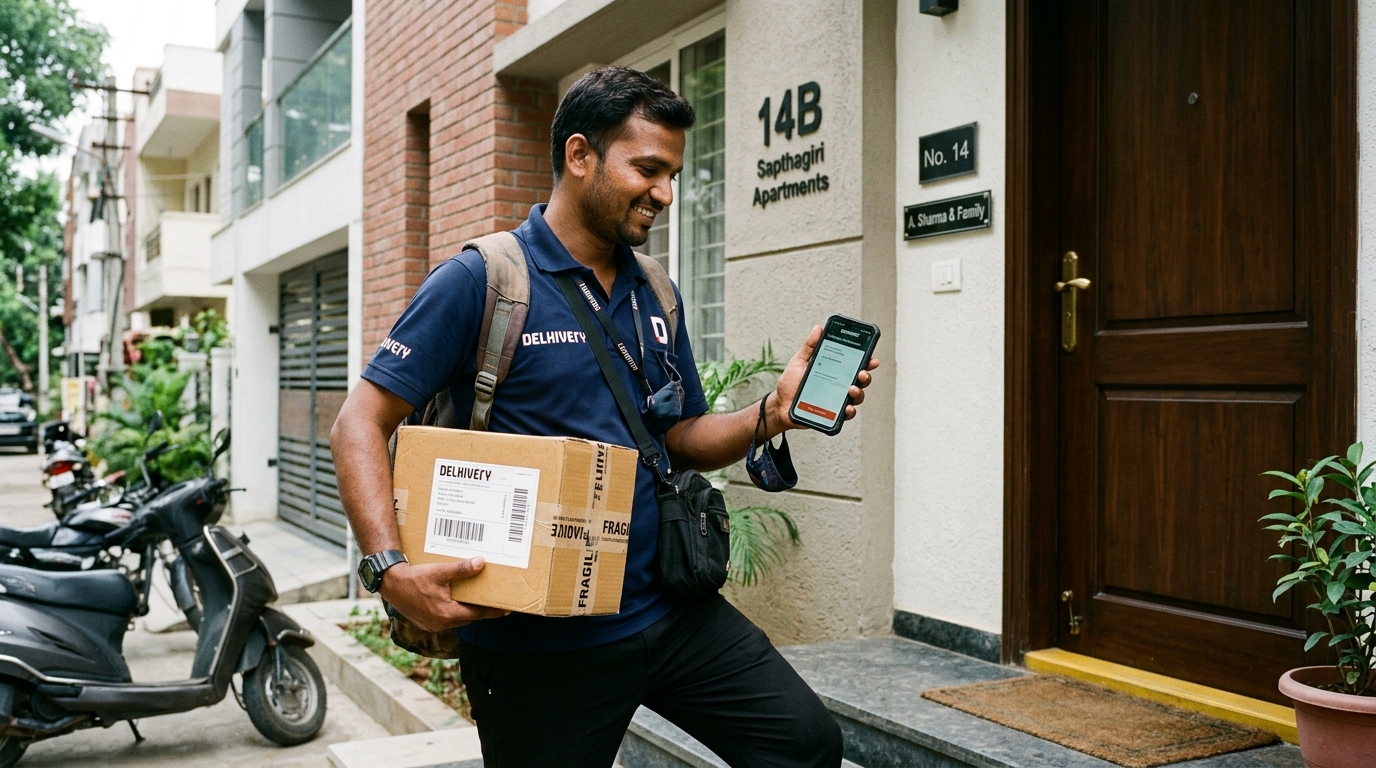
Customers today expect deliveries to be fast, trackable and, above all, confirmed. For logistics and delivery businesses in India, that last confirmation—proof that the right package reached the right person at the right place and time—is where trust is won or lost. Paper challans and handwritten signatures struggle to keep up with e-commerce, quick commerce, and B2B volumes, which is why more fleets are moving to digital proof of delivery (digital POD, also called ePOD) as part of their modern last-mile delivery software.
In this guide, you will learn what digital POD is, how it works step by step, what data it captures, how it compares with paper POD, and how it reduces delivery disputes. You will also find a simple checklist for choosing the right solution.
In Short
- ✓ Doorstep Verification: Digital POD records proof such as an electronic signature, photo, GPS location, timestamp, barcode scan, or OTP at the moment of delivery.
- ✓ Instant Evidence: The data reaches your control room in real time, so customer disputes are settled with tamper-proof evidence instead of memory.
- ✓ Eliminating Paper Costs: Paper POD is slow, error-prone, and easy to lose. Digital POD is searchable in seconds and scales seamlessly with order volume.
- ✓ Selection Criteria: Choose an ePOD solution based on TMS integration, driver usability, live GPS tracking, delivery analytics, and end-customer experience.
What Is Digital Proof of Delivery (POD)?
Digital proof of delivery (digital POD or ePOD) is an electronic record that confirms a shipment was successfully delivered. Captured on the driver’s smartphone or rugged handheld device at the doorstep, it combines evidence such as a customer signature, photo, GPS location and timestamp, barcode scan, or OTP, and shares it instantly with the business and, when needed, the recipient.
Unlike a paper challan that travels back to the depot days later, an ePOD is created at the point of delivery and stored in the cloud. It shows where the delivery happened, when it happened, and who accepted it, which is exactly what logistics teams require when an order status is questioned.
How Does Digital Proof of Delivery Work?
A modern digital POD system has two connected parts: a intuitive mobile app that delivery agents use to collect proof at each stop, and a central dashboard where dispatchers and fleet managers monitor, store, and analyse every delivery in real time.
The Five-Step Digital POD Workflow
Import Orders
Order details, addresses, and delivery instructions enter through ERP, TMS, OMS, API, or manual upload.
Sync to Driver
Drivers receive assigned stops on the app alongside an optimised route sequence and notes.
Capture Proof
At the doorstep, the driver collects a parcel photo, on-screen e-signature, barcode scan, or OTP.
Sync Real-Time
Proof, GPS coordinates, and timestamps reach the control room instantly for live status updates.
Analyse & Report
Dashboards generate first-attempt success rates, delivery turnaround times, and exception analytics.
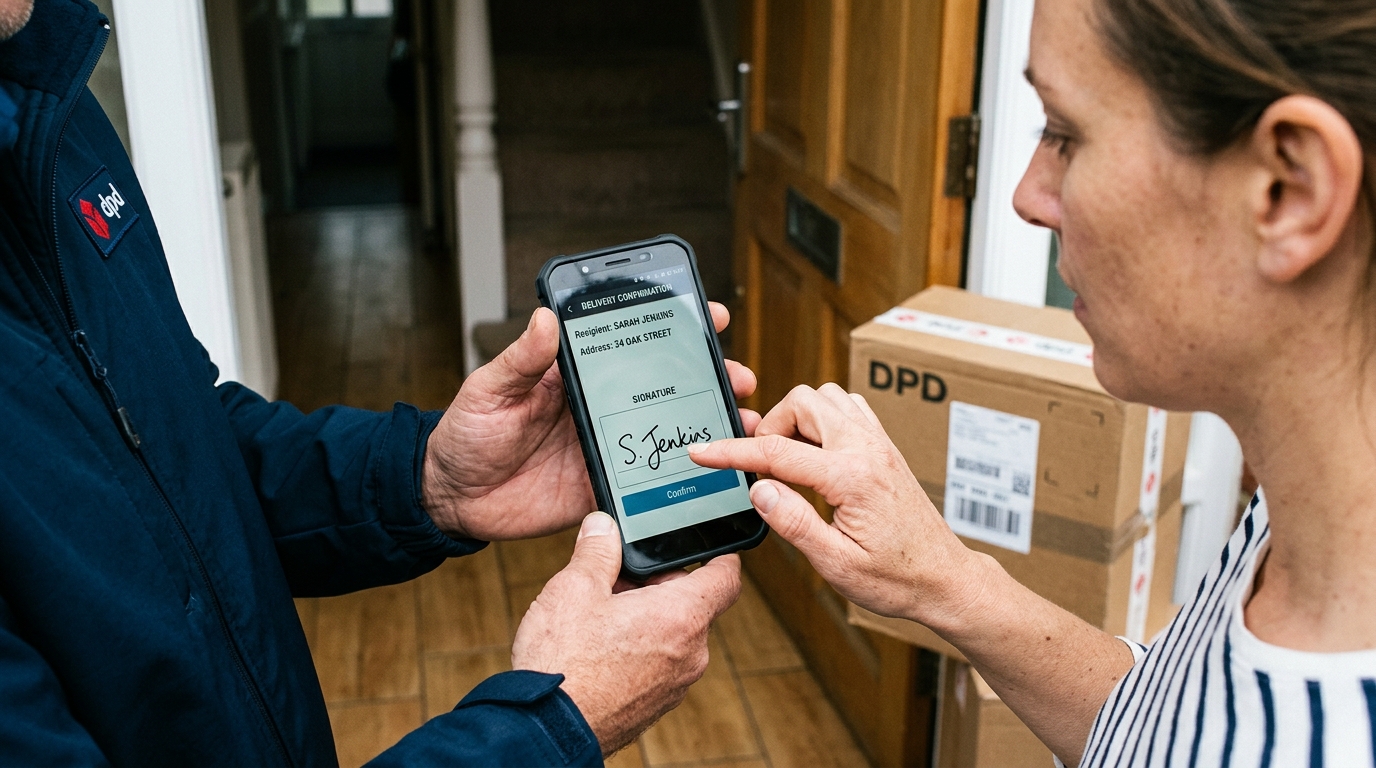
Figure 1: Contactless electronic signature capture and automated GPS timestamping on the driver's smartphone at the point of delivery.
What Information Does a Digital POD Capture?
A digital POD can be configured to match your unique operational requirements across B2B freight, e-commerce parcel delivery, and quick commerce. Common data types include:
Electronic Signature
The recipient signs with their finger or stylus directly on the driver's device screen.
Photographs
High-resolution camera captures showing the package placed safely at the doorstep or premise.
GPS Geotag & Timestamp
Exact latitude and longitude coordinates stamped precisely down to the second of delivery.
Barcode & QR Scan
Scans the shipping label on handover to verify the correct SKU and consignment number.
PIN or OTP Validation
A one-time passcode sent directly to the customer's phone for 100% contactless validation.
Notes & Custom Fields
Condition remarks, gate pass numbers, security check details, or cold-chain temperature readings.
Together, these records form an unbreakable digital chain of custody for every consignment, from central warehouse dispatch straight to the recipient's hands.
Digital POD vs Paper Proof of Delivery
For a business handling more than a few dozen deliveries a day, the difference between paper challans and digital POD is operational and financial, not merely cosmetic.
| Criteria | Paper POD (Challan) | Digital POD (ePOD) |
|---|---|---|
| Accuracy | Illegible handwriting, missing signatures, and manual re-keying errors. | Mandatory fields enforce complete, validated data capture with zero re-typing. |
| Speed | Physical slips return to headquarters days or weeks later, delaying confirmation. | Data syncs in real time; operations and billing teams see completion instantly. |
| Cost & Admin | Recurring printing, physical warehouse archiving, filing, and admin hours accumulate. | Zero paper consumption, reduced admin overhead, and accelerated invoice cycles. |
| Dispute Resolution | Challenging to verify; paper slips get smeared, torn, lost, or forged. | Time-stamped, GPS-tagged photographic evidence retrieved in seconds. |
| Contactless Delivery | Requires physical exchange of clipboard, pens, and paper documents. | Supports customer phone SMS links, OTP validation, and doorstep photo confirmation. |
| Environmental Impact | Heavy paper consumption and waste across thousands of deliveries daily. | 100% paperless workflow advancing corporate ESG and sustainability targets. |
| Scalability | Becomes completely unmanageable as shipment volumes expand across hubs. | Cloud-based architecture scales seamlessly from 50 to 500,000 daily orders. |
| Audit & Compliance | Manual archive retrieval takes days; missing records jeopardize customer billing. | Centralized, searchable cloud records ready for tax, regulatory, and insurance audits. |
Still using paper challans?
See how Roadcast captures proof of delivery in real time, automates billing, and eliminates lost delivery slips.
How Digital POD Reduces Delivery Disputes
Most delivery disputes boil down to one fundamental question: what actually happened at the doorstep? Digital POD answers it conclusively with time-stamped, geotagged evidence captured on the spot.
Before reaching the customer, a driver using an ePOD app can see everything required for a flawless handover: the assigned vehicle and load, driver ID, the customer’s delivery time slot, a live ETA, the GPS-validated address, itemised order details with special handling notes, and direct contact details with gate access instructions. With full context at every stop, fewer deliveries fail because of missing information.
When a dispute arises, digital evidence settles it in minutes:
-
“I never received it.”
The photo, OTP confirmation, or customer signature—paired with the exact timestamp and GPS geotag—verifies who accepted the order and where.
-
“Wrong address delivery.”
The system's automated geotag cross-references the driver's physical coordinates against the customer's delivery destination on the order sheet.
-
“Wrong or missing item.”
Doorstep barcode scanning and an itemised manifest verify that the exact SKU was handed over before the trip is marked complete.
-
“It arrived damaged.”
High-definition doorstep photos and condition remarks record the state of goods when they left the driver’s hands. For high-value or damage-prone cargo, pairing POD with in-vehicle footage from video telematics provides an additional, indisputable layer of evidence.
Because digital records are searchable in seconds, customer support teams can resolve claims during the initial phone call instead of spending days chasing paperwork across distributed distribution depots.
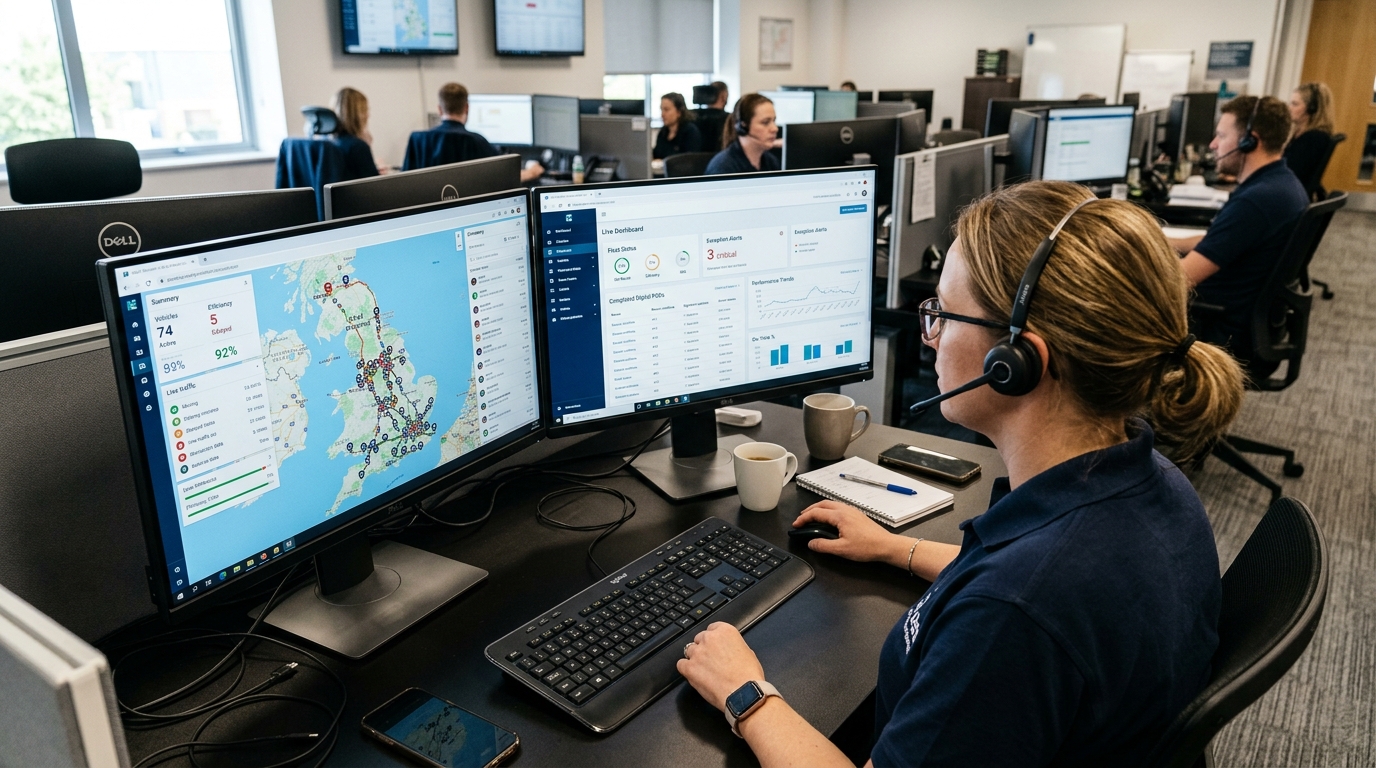
Figure 2: Centralized fleet dispatch control tower monitoring live deliveries, OTP confirmations, and exception analytics in real time.
Benefits of Digital Proof of Delivery for Fleets
A well-engineered digital POD solution delivers tangible operational returns for customers, delivery riders, and enterprise supply chain decision-makers:
Boosts Workforce Productivity
Drivers confirm deliveries directly through their mobile app, updating dispatchers in milliseconds. Eliminating manual paper management allows riders to complete faster stops and achieve higher daily order throughput.
Improves Customer Satisfaction
Automated SMS and WhatsApp notifications keep customers informed from depot dispatch to doorstep arrival. Immediate digital confirmation with photo proof eliminates ambiguity and prevents false delivery claims.
Provides Real-Time Supply Chain Visibility
ePOD feeds live status directly into your central dashboard and flags exceptions as they happen. Combined with enterprise fleet management software, this end-to-end visibility enhances fleet utilization, driver productivity, and route SLA compliance.
Cuts Paperwork & Human Error
The mobile application validates data at the point of capture and enforces mandatory fields, ensuring complete, consistent records without manual data re-entry or paper storage overhead.
Enables 100% Contactless Delivery
Support contactless handovers through SMS signature links, OTP/PIN validation, doorstep photo documentation, and GPS timestamps, verifying delivery securely without passing devices back and forth.
Reduces Failed Delivery Costs
Real-time alerts on failed deliveries help managers isolate root causes—whether an incorrect address, recipient unavailability, or access constraints—reducing costly redeliveries and wasted kilometres.
How to Choose a Digital POD Solution
When evaluating electronic proof of delivery software for your enterprise fleet, consider these five essential factors:
-
1. Compatibility and System Integration
The POD application must integrate seamlessly with your Transportation Management System (TMS), Warehouse Management System (WMS), ERP, and billing software via robust REST APIs. It should also run reliably on smartphones, tablets, and rugged Android handhelds.
-
2. Simple, Intuitive Interface for Drivers
If drivers require extensive training, adoption plummets. An intuitive, multilingual driver app speeds up onboarding, reduces doorstep mistakes, and minimizes driver turnover.
-
3. Real-Time Tracking and Two-Way Communication
Ensure the solution provides live delivery progress tracking and an instant communication channel between riders and central dispatchers to resolve exceptions dynamically.
-
4. Actionable Analytics and SLA Reporting
Look for customizable dashboards that track critical KPIs—such as first-attempt delivery rate, average doorstep dwell time, and exception ratios—to pinpoint route and process bottlenecks.
-
5. Modern Customer Experience Features
Features such as automated SMS/WhatsApp status alerts, live driver tracking maps, photo confirmation, and instant customer rating prompts elevate brand loyalty and trust.
How Roadcast Supports Digital Proof of Delivery
Roadcast’s last-mile delivery software empowers logistics, retail, and e-commerce businesses to capture digital proof of delivery in real time, including driver actions, ensuring dispatchers and customers have an immutable record of every order.
Roadcast ePOD works alongside an integrated logistics ecosystem:
- • Smart Auto-Assignment: Matches each delivery order with the closest available rider and calculates multi-order route optimisation to minimize deadhead kilometers.
- • Dedicated Driver App: Enables real-time order status updates, navigation, customer instructions, and shift management.
- • Real-Time Exception Alerts: Instant notifications for delayed deliveries, route deviations, and doorstep geofence breaches.
- • Cash on Delivery (COD) Tracking: Accurate doorstep payment recording and end-of-day cash reconciliation.
- • Enterprise Integrations: Pre-built connectors and flexible APIs for SAP, Oracle, Shopify, WooCommerce, and custom ERP/TMS platforms.
Fewer disputes. Faster invoicing. Full delivery visibility.
Equip your delivery fleet with tamper-proof digital proof of delivery and settle customer claims with real-time doorstep evidence.
Conclusion
Speed alone no longer wins in modern last-mile delivery. Customers demand tight delivery windows, live order tracking, and clear, transparent confirmation when the package arrives. Digital proof of delivery looks like a small step in the broader delivery chain, but it safeguards your revenue, your drivers, and your customer relationships.
Moving from vulnerable paper challans to digital POD equips your operations team with evidence they can act on immediately and delivers an experience your customers can rely on every single time.
Related Blogs
Frequently Asked Questions
What is digital proof of delivery?
Digital proof of delivery (digital POD or ePOD) is an electronic record confirming that an order reached the right location and was accepted by the right person. It is captured on a driver’s mobile device using a signature, photo, GPS timestamp, barcode scan or OTP.
How does digital POD work?
Orders are imported through ERP or TMS integration and synced to the driver’s app with an optimised route. At the doorstep, the driver captures proof such as a signature, photo, barcode scan or OTP. The proof, with GPS coordinates and a timestamp, syncs instantly to the dashboard, where analytics track KPIs, exceptions and reports.
What information does a digital POD include?
A digital POD can include an electronic signature, photographs, GPS geotag and timestamp, barcode and QR scans, notes and custom fields, PIN or OTP validation, and ID verification, depending on how your operation configures it.
How does digital POD reduce delivery disputes?
It replaces memory and paperwork with evidence captured at the doorstep. A time-stamped, location-stamped photo, signature or OTP confirmation shows what was delivered, where and to whom, so claims such as non-delivery, wrong address or damaged goods can be checked in minutes.
Is digital POD better than paper POD?
For most operations, yes. Digital POD removes the delays of manual entry, the risk of lost or illegible slips and the difficulty of verifying a delivery afterwards. It also supports contactless confirmation through photo and OTP and scales to high delivery volumes where paper becomes unmanageable.
Can digital POD integrate with fleet tracking systems?
Yes. Digital POD data can flow into ERP, TMS, WMS, OMS, billing and claims systems, and it complements fleet tracking by adding delivery confirmation to live vehicle and rider location. Together they give you one view from dispatch to doorstep.