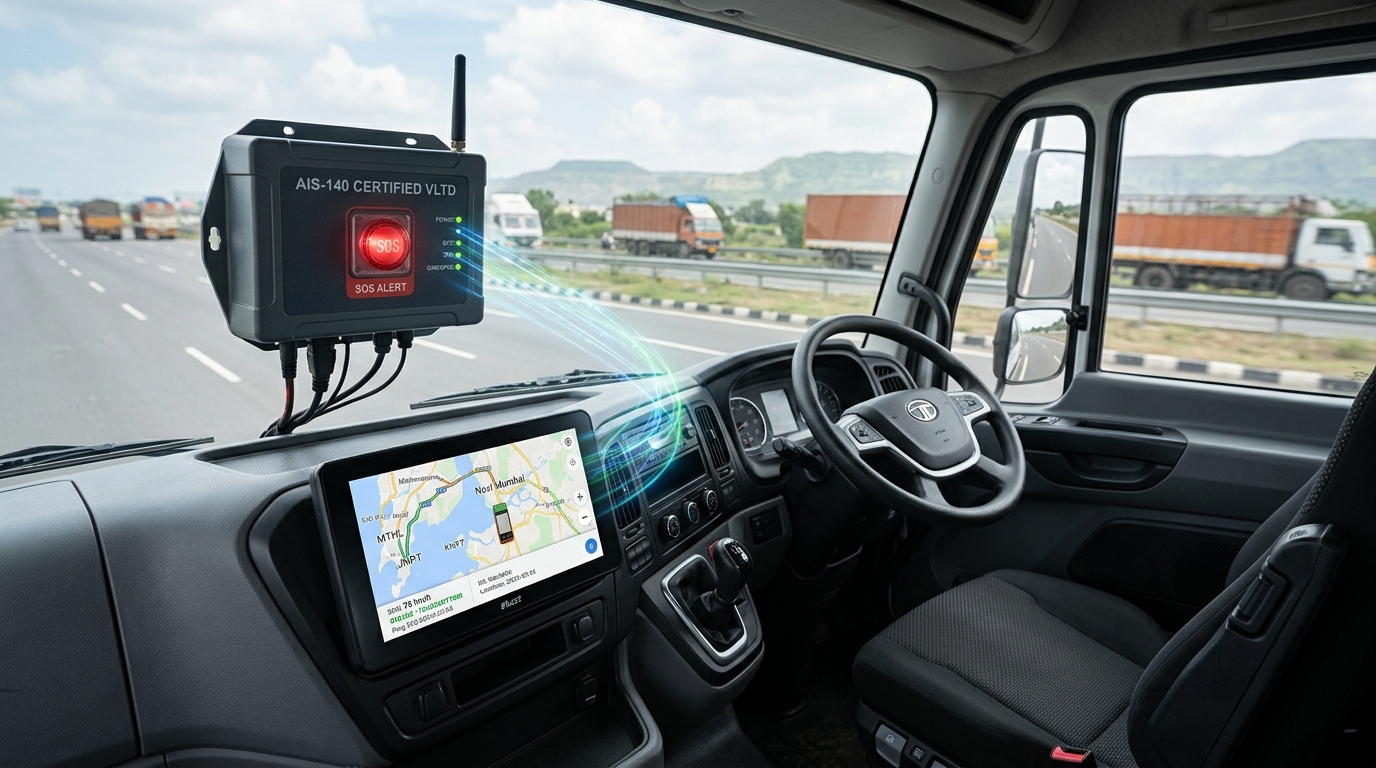
India has one of the highest road accident rates in the world, and a significant percentage of serious accidents have historically involved commercial and public transport vehicles. Before AIS-140, enforcement relied on physical inspections and manual checks - a bus could break down, go off-route, or be involved in an accident, and it could be hours before anyone knew. AIS-140 was designed to fix that gap. The standard creates a government-connected Intelligent Transportation System (ITS) that gives authorities real-time visibility into commercial vehicle movement across the country. It matters now more than ever because enforcement has moved from a paperwork formality to a hard requirement - non-compliant vehicles risk losing their fitness certificate and, with it, the right to operate.
What Is AIS-140?
AIS stands for Automotive Industry Standard. Standard 140 was developed by the Automotive Research Association of India (ARAI) under the authority of the Ministry of Road Transport and Highways (MoRTH). AIS-140 VLTD (Vehicle Location Tracking Device) is a government-approved GPS tracking system designed for both commercial and passenger vehicles.
Origin - the MoRTH Mandate and the Nirbhaya Fund Context
Following the 2012 Delhi gang-rape case, widely known as the Nirbhaya case, safety recommendations from the Justice J.S. Verma Committee provided the initial push for embedding panic buttons and tracking systems in public transport.
The MoRTH Mandate
MoRTH introduced formal requirements under Rule 125H of the Central Motor Vehicles Rules, 1989. Its core purpose is to mandate the use of Intelligent Transportation Systems (ITS) - specifically Vehicle Location Tracking Devices (VLTDs) and emergency panic buttons - in public service and commercial vehicles.
- Vehicle Tracking: legally mandates the fitment of tracking units to help protect women and children using public transit.
- Emergency Systems: integrates panic buttons and distress signals in public buses, linked to local law-enforcement control rooms.
- Hardware Parameters: defines the technical specifications every AIS-140 device must meet.
- VAHAN Portal Integration: Regional Transport Offices (RTOs) enforce compliance by tying it directly to vehicle registration data and the mandatory fitness certificate.
- Emergency Response: when a passenger presses the panic button inside an AIS-140-compliant vehicle, an automated alert - including vehicle logs, driver details, and real-time coordinates - is sent directly to local police and the Emergency Response Support System (ERSS) dispatch units.
The Nirbhaya Fund Context
The Government of India set up the Nirbhaya Fund, a ₹1,000-crore non-lapsable corpus created in the 2013 Union Budget and administered by the Ministry of Finance, to fund initiatives that enhance women's safety. One scheme under this fund, the One Stop Centre (OSC) Scheme, has operated across the country since 1 April 2015, offering women affected by violence integrated police facilitation, medical aid, and legal and psycho-social counselling under one roof.
Grants from the Nirbhaya Fund are also disbursed to state and union-territory administrations to build unified, state-wise vehicle tracking platforms and backend monitoring command centres - the infrastructure that AIS-140 data ultimately feeds into.
Regular GPS Tracker vs. AIS-140 Certified Device
A regular GPS tracker provides basic location data and is not certified by any government authority. An AIS-140-compliant device must meet specifications set by MoRTH and the Bureau of Indian Standards (BIS), including a mandatory SOS panic button, dual-IP data transmission to both transport and emergency authorities, tamper-proof casing, an embedded M2M SIM, and a minimum 4-hour battery backup - none of which are required in a standard commercial GPS tracker.
Who Needs an AIS-140 Certified Device?
AIS-140 compliance is compulsory in India for all public service and commercial transport vehicles. Regulated by MoRTH, it requires installing a certified Vehicle Location Tracking Device (VLTD) that sends real-time location data to government servers such as the Vahan portal, along with a physical panic button.
AIS-140 compliance is required for every commercial vehicle operating with a yellow number plate, including:
- Buses: public transport (state-run and private operators), school buses, and staff buses carrying employees
- Taxis, cab operators, and aggregator fleets
- Inter-state trucks and goods carriers
- Ambulances and emergency service vehicles
- Any vehicle operating a passenger service on a transport permit
If you're unsure whether your vehicle category is covered, check with your state RTO directly.
State-wise Enforcement Status
AIS-140 enforcement is fully digital and integrated with the national Vahan portal, making certified VLTD fitment mandatory for commercial fitness renewals and permits across every Indian state. High-enforcement states run active roadside and RTO checkpoint inspections, while others tie compliance directly to digital transit clearances.
- Active Enforcement Hubs (Gujarat, Maharashtra, Karnataka, Telangana): strict physical and camera-based tracking, with zero tolerance for uncertified hardware during routine operations or inter-state transit checks.
- Growing Compliance Zones (Uttar Pradesh, Rajasthan, Delhi-NCR, Tamil Nadu): mandatory integration strictly enforced for public buses, school transport, and national-permit freight trucks via local RTO portals.
- General Rollout States (remaining UTs and regional circles): phased alignment, with tracking verified mainly at annual fitness renewals and fresh commercial registrations.
Key Features of an AIS-140 Compliant System
AIS-140 certified GPS trackers are mandatory for public and commercial vehicles, ensuring compliance with regulations that strengthen operational safety. A standard GPS tracker and an AIS-140 certified device are not the same thing - a regular tracker shows location; an AIS-140 device has to meet a far more specific set of requirements.
- Live Tracking: precise, real-time position updates for better fleet management and operations.
- Emergency Buttons: panic buttons that let passengers or drivers instantly send emergency alerts to central response teams.
- Data Connectivity: cellular and satellite links stream data to central monitoring systems without dropouts.
- Tamper-Proof Design: tamper-resistant hardware preserves data validity, which is required for compliance.
- Vehicle Diagnostics: advanced diagnostics report on fuel consumption, engine condition, and driver behaviour, helping operators cut downtime and repair costs.
- Integration Features: AIS-140 trackers integrate easily with existing fleet management systems, extending data reach and operational control.
Panic Button & Emergency Alerts
India's passenger transport ecosystem is undergoing a major transformation, with vehicle safety, real-time tracking, and regulatory compliance at its core. At the centre of this shift is a small but powerful device: the AIS-140 panic button, an essential part of the Vehicle Location Tracking Device (VLTD) mandated under AIS-140 standards.
It lets passengers or drivers instantly trigger an SOS alert for:
- Emergencies
- Accidents
- Security threats
- Medical situations
Workflow
- The passenger or driver presses the panic button.
- The AIS-140 VLTD captures vehicle ID, GPS location, timestamp, speed, and emergency event data.
- The alert is transmitted through the configured cellular network.
- The alert reaches a centralised command centre.
- Fleet admins or control-room users can view the emergency location and vehicle details.
- The event is stored for audit, reporting, and compliance review.
- An automatic warning triggers if anyone attempts to disconnect, damage, or disable the tracking hardware.
This life-saving feature isn't only about compliance - it enables faster emergency response, safer journeys, and smarter fleet management.
Real-Time Location Reporting Intervals
Under the AIS-140 standard, Vehicle Location Tracking Devices are typically configured to report data every 10 to 60 seconds while the vehicle is in motion, with 10 to 30 seconds being the standard requirement for live government and emergency-tracking server synchronisation.
Reporting Modes & Intervals
- Normal Tracking (Moving): transmits location, speed, and heading every 10–30 seconds (adjustable based on state transport/RTO mandates or platform configuration).
- Idle/Stoppage State: to conserve data and power when the vehicle is stationary, intervals typically drop to a longer heartbeat frequency (e.g., every 5 minutes or longer).
- Emergency/Panic Event: immediate, continuous high-frequency burst transmission the moment the SOS button is pressed.
- Configurable Range: parameters can be adjusted via Over-The-Air (OTA) commands from 5 seconds up to several minutes, depending on state RTO requirements.
SIM-Based Data Transmission Standards
AIS-140 regulates SIM-based data transmission for commercial vehicles in India. It mandates embedded, tamper-proof M2M SIMs that securely stream real-time GNSS location and speed data, along with emergency SOS alerts, over cellular networks (2G/3G/4G) to multiple authorised government and emergency-response servers.
Network & SIM Specifications
- Embedded/eSIM Structure: uses an embedded chip-based M2M SIM (or dual-profile eSIM) to prevent physical theft, swapping, or tampering.
- Network Redundancy: supports multi-operator or quad-band GSM/GPRS with seamless fallback for unbroken coverage across remote highways.
- Fallback Options: primary data transfer happens via GPRS/TCP-IP, with SMS as a backup if data networks fail.
Server Transmission Protocols
- Multiple IP Destinations: must concurrently stream data to at least two primary/secondary government IP addresses (such as state transport command centres) plus an emergency/panic response IP address.
- Transmission Frequency: configurable packet intervals from 5 seconds (during active movement) up to 10 minutes (when idling or parked).
- Data Packet Contents: includes the vehicle's unique identifier, latitude, longitude, velocity, heading, timestamp, and digital/analog input status (such as emergency-button triggers).
Storage & Operational Safeguards
- Store and Forward: internal non-volatile memory logs at least 40,000 data messages when connectivity drops, automatically forwarding cached logs once the cellular connection is re-established.
- Over-The-Air (OTA): fully supports remote firmware updates and server IP reconfiguration.
- Power Safeguards: an internal backup battery supports at least 4 hours of continuous data transmission if the main vehicle battery is disconnected.
Business Benefits Beyond Compliance
What you actually get from AIS-140 compliance:
- Accurate customer ETAs: real-time location means you can tell customers exactly when to expect delivery, without calling the driver every 30 minutes.
- Driver behaviour monitoring: speed alerts, harsh-braking tracking, and idle-time reports catch risky behaviour before it becomes an accident or an insurance claim.
- Verifiable route history: 90 days of GPS data gives you an irrefutable record for billing disputes or delivery proof.
- Automated maintenance reminders: odometer-based service alerts prevent "we forgot the service was due" breakdowns.
- Fuel theft detection: fuel drops that don't match distance travelled get flagged; AIS-140 devices track vehicle performance, not just location.
- Measurable safety gains: fleets that combine GPS tracking with driver-behaviour monitoring consistently report meaningful drops in accident frequency, translating into lower repair costs and fewer insurance claims.
Operational intelligence: live trip logs, route replay, idle-time tracking, and geofence alerts let transport managers manage vendor performance in near real time.
Safety, Insurance, and Operational Visibility Gains
The AIS-140 tracking system offers several operational and safety advantages:
- Better Fleet Visibility: fleet managers can track every commercial vehicle from a single place.
- Decreased Fuel Wastage: driver monitoring and route optimisation boost fuel efficiency.
- Improved Traveller Safety: emergency alert systems improve safety for passengers and drivers.
- Enhanced Compliance: AIS-140-compliant systems help businesses meet transport-department regulations.
- Better Operational Control: fleet owners can monitor routes, driver performance, and trips more effectively.
- Better Vehicle Security: continuous tracking helps reduce theft and unauthorised use.
- Reduced Insurance Premiums: with demonstrably safer operations, insurers may offer lower premiums.
Industry Use Case: Logistics Fleet
A global logistics company approached Roadcast to solve several operational issues, including:
- Limited visibility into driver behaviour on the road, including an inability to detect fatigue, drowsiness, and other risky patterns
- No reliable recording of accidents or incidents for evidence and analysis
- Risk to the safe movement and handling of cargo
- Inaccurate route mapping and trip tracking, including undetected blind spots
- No way to measure vehicle idle time, causing fuel and productivity loss
- Incomplete trip details (start/end time, duration, distance)
Roadcast recommended installing a 4-channel dashcam with ADAS (Advanced Driver Assistance System) and DMS (Driver Monitoring System) in each vehicle. The benefits began to show almost immediately:
- Real-time GPS coordinates enabled continuous, live vehicle tracking and eliminated side blind spots.
- Automated alerts triggered instantly on driver violations, cross-checked against past incident recordings for pattern analysis; early fatigue/drowsiness detection reduced accident risk and improved driver accountability.
- Route optimisation led to more efficient trips, fuel savings, and faster deliveries.
- Lower idle time improved fuel efficiency and asset utilisation.
- Reliable video evidence supported incident investigation, insurance claims, and dispute resolution.
- Safer cargo handling reduced in-transit damage and loss.
Statistics & Trends: State Rollout Data and Penalty Enforcement
AIS-140 enforcement in India has moved from manual, paper-based checks to digital, transaction-linked verification. In May 2026, the Supreme Court - hearing the long-running road-safety case S. Rajaseekaran v. Union of India - directed states to ensure that public service vehicles are fitted with VLTDs and panic buttons, and gave states the authority to withhold a fitness certificate until both are installed and reflected on the Vahan portal. That single direction turned a decade-old rule into a hard condition attached to the one document no commercial vehicle can operate without.
Device manufacturers upload every unit's details to the Vahan database, so compliance status can be checked directly at the RTO counter. The Parivahan Sewa portal lists the VLTS ecosystem for national vehicle tracking among its official services, with manufacturer and device registration handled through the VLTD Maker portal on Vahan, and monitoring carried out through each state's own VLTS portal.
States broadly follow one of three enforcement approaches: portal-verified compliance, a fixed installation window with notified pricing, or challan-backed roadside inspection. Most states operate somewhere on this spectrum, which is why compliance planning needs to be done state by state rather than assumed to be uniform nationally. States now have explicit judicial backing to refuse a fitness certificate - and, by extension, continued operation - to any public service vehicle whose VLTD and panic button aren't installed and visible on Vahan. Gujarat, Maharashtra, Karnataka, and Telangana currently show the highest volumes of active rollout and roadside checks.
Penalty & Enforcement Trends
- Fitness Renewal Blocks: digital verification at RTO counters automatically fails fitness-certificate renewals for non-compliant vehicles.
- Spot Fines: on-the-spot financial penalties for operating non-compliant hardware during roadside interceptions.
- Permit & Contract Risk: authorities routinely suspend or revoke transport route permits, and non-compliant operators risk exclusion from government and institutional logistics tenders.
How to Implement AIS-140 Compliance: Step by Step
Buying a certified device is only step one - installation is where many operators make avoidable mistakes.
- Step 1 - Buy from a certified manufacturer or authorised reseller: Verify the ARAI or ICAT approval number before purchase; if the vendor can't show it, don't buy.
- Step 2 - Get installation done by an RTO-empanelled vendor: This isn't a DIY job. The device must be hardwired into the vehicle's power system and ignition line by an authorised, RTO-recognised installer - a non-empanelled workshop doesn't count, even if the work itself is technically sound.
- Step 3 - Register on the Vahan portal with accurate vehicle details: Chassis number, engine number, and owner information must all be entered correctly. Without portal registration, the device isn't officially linked to your vehicle in the government system - you're not compliant even if the hardware is physically installed.
- Step 4 - Obtain and keep your installation certificate: You'll need it during fitness renewal and RTO inspections, so keep it with your vehicle documents at all times.
- Step 5 - Verify that data is transmitting to the government server: After installation, confirm the device is actively sending data to the Vahan/NIC server, not just to your fleet dashboard. Both must be active simultaneously.
Choosing a Certified Device
Not every device marketed as "AIS-140 compliant" actually is. Installing a non-certified device doesn't make you compliant - it just means you've spent money on hardware that won't hold up at an RTO inspection. Before purchasing, verify:
- The ARAI or ICAT approval number is printed on, or documented with, the device - no number means it isn't compliant.
- The panic button is built in as standard, not sold as an optional add-on.
- The device supports dual-IP transmission to both the government server and your fleet platform simultaneously.
- IP65 weather-resistance rating is confirmed on the spec sheet.
- OTA firmware-update support is included, guaranteeing long-term compliance as standards evolve.
- Internal power backup is included - ask the vendor to confirm the backup duration.
Fitment and RTO Registration Process
Installation of AIS-140 VLTDs must follow specific guidelines to ensure proper functioning and resistance to tampering, and must be performed by a trained, authorised technician.
- Appropriate Hardware: choose an AIS-140-compliant, RTO-empanelled VLTD unit with an emergency panic button.
- Authorised Installation: have a certified technician install the hardware and panic button securely inside the vehicle.
- SIM Activation & Data Mapping: activate the embedded M2M SIM card and map the device's serial number/IMEI to your vehicle registration on the state's tracking portal (such as the Delhi VLTS Dashboard or the equivalent regional transport server).
- Obtain Certificate: receive the official VLTD installation and testing certificate confirming that live tracking data is successfully routing to the government command centre.
RTO Registration and Verification Process
- Document Submission: submit the physical VLTD certificate, along with standard vehicle papers (RC, insurance, and permit files), at the regional Parivahan Vahan Portal-linked RTO office.
- System Validation: the RTO inspector or an automated system cross-checks the vehicle's chassis/registration number against the live data feed from the empanelled tracking server.
- Fitness & Permit Approval: once the fitness test confirms live data transmission and panic-button responsiveness, the RTO issues the fitness certificate (FC), national permit, or new commercial registration.
Integrating with a Fleet Management Platform
AIS-140 was designed for security and regulation, but in 2026, fleets need more than compliance - they need visibility, control, and intelligence. Roadcast trackers are built specifically for Indian fleet operations and AIS-140 compliance, providing certified solutions, real-time fleet visibility, route intelligence, control-room dashboards, and government integration (Vahan/RTO workflows).
Integrating an AIS-140 device with a fleet management platform requires dual-destination data streaming: telemetry packets must be pushed simultaneously to authorised government/Vahan backend servers and to your private fleet management software, via TCP/IP endpoints and API forwarding from the hardware.
Common Compliance Challenges
Many commercial vehicles are operated by small, individual owner-operators with limited awareness of compliance requirements, so AIS-140 implementation has faced challenges across the industry, including:
- Using generic, cheap GPS units instead of mandated ARAI/ICAT-certified VLTDs that fail regional RTO inspections.
- Improper physical installation or hardwiring of SOS emergency buttons, leading to intermittent signal failures during tests.
- Failing to maintain the mandatory internal 4-hour battery backup when the main vehicle ignition is off or disconnected.
- Backend fragmentation, as different states run their own VLTS portals with varying levels of technical maturity - making it harder to configure devices to stream live telemetry to both private fleet software and official government endpoints like the Vahan portal simultaneously.
- Connectivity gaps in rural and remote areas, leading to data blackouts for long-haul vehicles.
- Driver resistance stemming from limited awareness of why the system is being installed.
- Recurring SIM and backend costs that are harder for individual owner-operators of goods vehicles to absorb relative to their margins.
Device Cost and Fitment Challenges
The total first-year cost of AIS-140 compliance is approximately Rs. 4,800–Rs. 15,800 per vehicle, covering:
- VLTD hardware: Rs. 4,000–Rs. 14,000, including the M2M SIM and data plan
- Installation: Rs. 500–Rs. 1,000
- Backend software subscription: Rs. 300–Rs. 800 per year
Volume pricing may apply for large fleets.
Fitment and Compliance Delays
High volumes and strict enforcement create holdups in appointment booking and certificate issuance at Regional Transport Offices, resulting in backlogs and delays. Device serial numbers or dealer installation certificates sometimes fail to map instantly to the national vehicle registry database, adding further delay. Limited availability of certified vendors in smaller towns also creates scheduling delays for fitment and testing.
Connectivity in Remote Regions
- Cellular Drop-offs: heavy reliance on GSM/GPRS networks means network unavailability can interrupt live tracking.
- Data Buffering: once cellular coverage is restored, the hardware's internal memory stores telemetry offline and automatically uploads it.
NavIC/GNSS Role: regional satellite positioning (NavIC/IRNSS) can accurately determine a vehicle's coordinates even without mobile towers, but an active cellular connection is still required to transmit those coordinates to authorities in real time.
Future Outlook: ITS Expansion, Tighter Enforcement, and E-Challan Integration
- National integration of vehicle-tracking systems with the Parivahan Sewa portal is tied directly to vehicle fitness certificates.
- Telematics' role in delivery operations continues to grow - upcoming trends include forecasting delays and maintenance needs, monitoring EV battery performance and charging cycles, and combining AIS-140 GPS with fuel, temperature, remote-immobilisation, and cargo sensors for complete visibility.
- Reliance on indigenous satellite positioning for high-accuracy mapping is expected to deepen as ISRO expands the NavIC constellation.
- API specifications have been revised to standardise data across states and reduce the integration friction that multi-state fleet operators previously faced.
- Combining AIS-140 tracking data with FASTag systems - an integration the National Highways Authority of India is actively exploring - could create a more complete commercial-vehicle monitoring ecosystem on national highways.
Enforcement is shifting from manual officer inspections to automated digital logs. For annual fitness renewals, devices are linked directly to the Vahan database, and traffic violations increasingly trigger automated e-challans without requiring physical police intervention, streamlining fine issuance across state borders. Vehicles that miss compliance deadlines face escalating penalties, including permit cancellation and impoundment.
How Roadcast Delivers End-to-End AIS-140 Compliance
From certified hardware and installation to Vahan integration and compliance certificates, Roadcast manages the full deployment so your team doesn't have to. With ten years of experience, Roadcast is one of India's leading fleet platforms - compliance is built into your fleet operations from day one, so there's no need to coordinate with multiple vendors.
- Zero RTO Legwork: we handle certification directly, without endless paperwork or repeat office visits.
- Install to Certify, Fully Managed: device supply, installation, Vahan linkage, and backend setup are all handled by Roadcast.
- Built for Every Industry: logistics, mining, passenger transport, and cold chain all run on one platform.
- Transparent Pricing: standard pricing with no hidden deployment charges or surprise add-ons.
Simplify AIS-140 compliance with Roadcast - one deployment partner, zero compliance headaches. Roadcast is trusted because it combines robust hardware and real-time telematics with ARAI certification and MoRTH compliance, both required for regulated vehicle operations. It supports a panic button, tamper alerts, secure data protocols, and mandated reporting formats. Get in touch with our team today to streamline your fleet compliance.
FAQs
What is AIS-140, and why was it introduced?
AIS stands for Automotive Industry Standard. Standard 140 was developed by ARAI under MoRTH's authority to address India's high rate of commercial and public-transport accidents. Before AIS-140, enforcement relied on manual, physical inspections, so authorities had little real-time visibility into vehicle movement. AIS-140 introduced a standardised, government-connected Intelligent Transportation System (ITS) that closes that visibility gap.
Is AIS-140 mandatory for all commercial vehicles in India?
Yes, for every commercial vehicle operating with a yellow number plate, including:
- Public transport buses (state-run and private operators), school buses, and staff buses carrying employees
- Inter-state trucks and goods carriers
- Taxis, cab operators, and aggregator fleets
- Any vehicle operating a passenger service on a transport permit
- Ambulances and emergency service vehicles
What's the difference between a regular GPS tracker and an AIS-140 certified device?
A regular GPS tracker only provides basic location data and isn't certified by any government authority. An AIS-140-compliant device must meet MoRTH and Bureau of Indian Standards (BIS) specifications, including an SOS panic button, dual-IP data transmission to transport and emergency authorities, tamper-proof casing, an embedded M2M SIM, and a minimum 4-hour battery backup.
Do school buses need AIS-140 GPS tracking?
Yes. School buses need an ARAI-certified VLTD with a panic button accessible to both the driver and the bus attendant. Real-time monitoring data must be available to school management, parents, and traffic authorities, and must feed into the state's VLTS portal. Several states additionally require integration with school-specific tracking portals or parent-facing apps, and the Supreme Court's directions and the MoRTH School Bus Policy add further requirements on top of the base AIS-140 mandate.
How much does an AIS-140 certified GPS device cost?
As of 2026, the total first-year cost of AIS-140 compliance is approximately Rs. 4,800–Rs. 15,800 per vehicle - covering VLTD hardware (Rs. 4,000–Rs. 14,000, including the M2M SIM and data plan), installation (Rs. 500–Rs. 1,000), and a backend software subscription (Rs. 300–Rs. 800 per year). Volume pricing may apply for large fleets.
Can I use my existing GPS tracker, or must I replace it to be compliant?
Not every GPS tracker qualifies as an AIS-140 device. A compliant device must be type-approved and tested by an authorised agency - typically ARAI or ICAT - and must appear on the approved/empanelled list your state and its backend provider accept.
- Check the test certificate and the certifying agency (and its certificate number).
- Confirm the exact model is on your state's empanelled list.
- Confirm the vendor handles backend registration, not just the hardware.
If your existing tracker meets all three conditions, you don't need to replace it.
What data does an AIS-140 device transmit?
- Location, speed, and heading, used for accurate customer ETAs
- Driver behaviour data for monitoring and coaching
- Verifiable route history - up to 90 days of GPS data
- Odometer data for automated maintenance reminders
- Fuel-level data for theft detection
- Operational data: live trip logs, route replay, idle-time tracking, and geofence alerts
What happens when network connectivity is temporarily lost?
AIS-140 devices are designed with onboard memory that logs location and event data locally when the network drops. Once connectivity is restored, the cached data is automatically forwarded to the server, so no tracking history is lost - even in low-coverage areas.
Conclusion
What most enterprise operators don't realise is that AIS-140 devices are designed for regulatory reporting, not fleet management. There's a substantial gap between what the mandate requires and what best-in-class fleet intelligence actually delivers. By pairing telematics technology with the AIS-140 mandate, companies can cut costs, improve performance, and deliver a stronger customer experience. One device, two objectives: compliance and real fleet visibility, both from the same installation.
Schedule a demo with Roadcast to see how we deliver full AIS-140 compliance combined with modern fleet telematics intelligence.
Related Blogs
How New Tech and Rules Are Coming Together to Make Our Roads Safer
Enterprise Compliance in Fleet Operations: Audits, Evidence & Digital Trails
ADAS for Commercial Vehicles: The Complete Guide for Indian Fleet Managers (2026)
Driver Fatigue & Road Accidents: How AI Dashcams Detect Sleep Before It's Too Late