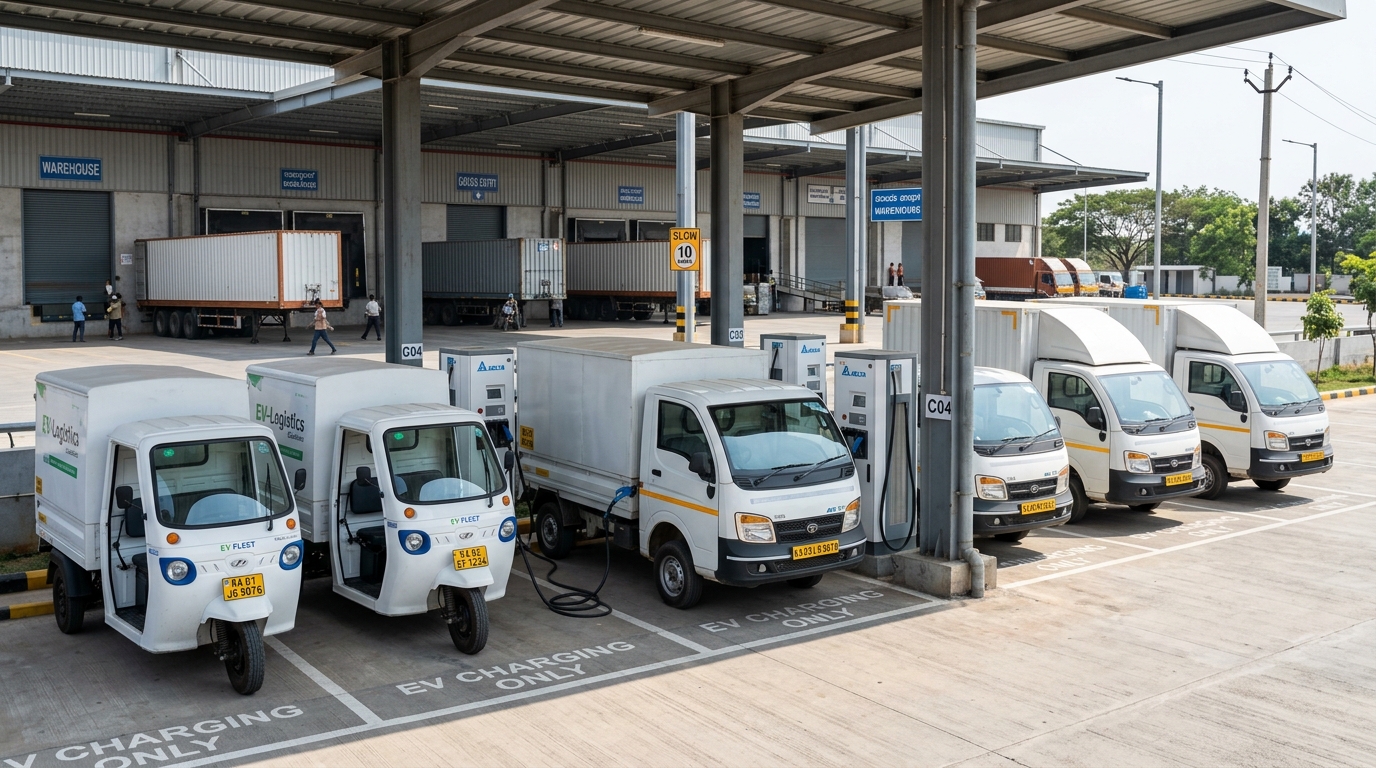
EVs are promoted as a comprehensive solution to many issues in India, such as air pollution and high oil import costs that drain foreign exchange reserves. The government plays a crucial role in promoting EVs in India. It does this by setting rules, offering incentives, and enforcing laws. This helps encourage more people to use electric cars, which helps the environment and reduces our need for petrol. It also fosters innovation and new ideas to improve electric cars.
However, moving from pilot deployments to scalable commercial electric operations requires far more than substituting fuel with kilowatt-hours. Fleets require specialized fleet management solutions that can monitor real-time battery health, optimize charging schedules, prevent depot grid overloads, and eliminate range anxiety on delivery routes.
Why Are Fleets Moving to Electric Vehicles?
As economics, technology, and policy finally align, fleets across India's urban and regional networks are switching to electric commercial vehicles. Fuel price volatility, stricter emission regulations, and growing sustainability mandates are forcing operators to reassess long-term vehicle strategies. Switching to an electric fleet can significantly reduce operational costs and improve sustainability.
The advantages are:
- Immediate and Long-Term Cost Savings: Electricity offers lower per-kilometer operating costs compared to diesel or petrol, shielding operators from fuel price shocks.
- Reduced Environmental Impact: Zero tailpipe emissions help logistics operators meet corporate sustainability mandates and net-zero targets.
- Reduced Maintenance: Electric powertrains have far fewer moving parts than internal combustion engines (ICE), minimizing mechanical wear and routine servicing requirements.
- Enhanced Fleet Management: Modern EVs natively generate rich telemetry data, enabling granular oversight into vehicle performance and energy dynamics.
- Government Incentives and Tax Breaks: Subsidies, lower GST rates, road tax exemptions, and priority access in congested urban corridors accelerate the return on investment.
- Enhanced Brand Image: Green delivery fleets enhance corporate reputation and position businesses as responsible, forward-thinking sustainability leaders.
What are the Key Challenges of Managing an EV Fleet?
EVs and fleet management software offer many benefits, but several challenges remain in managing fleets effectively.
Charging infrastructure: Drivers living in multi-family housing or apartments often lack dedicated overnight home-charging options. Public fast chargers are still unevenly distributed, making long-distance travel difficult outside major metropolitan areas. Rapidly growing power demands from high-power EV chargers can stress local electrical grids and require major utility upgrades.
Charging time: Even fast chargers take significantly longer to replenish a battery than it takes to fill a gas tank.
Battery Degradation: Electric vehicle (EV) batteries can degrade over time, reducing range and power.
Range Anxiety: Drivers worry about running out of battery power before reaching their destination or finding a working charger.
Initial Cost Difference: EVs usually cost less to operate but are very expensive upfront.
Driver training: To get maximum range from electric vehicles, drivers also need training on regenerative braking, smooth acceleration, and speed discipline.
Maintenance: An electric vehicle (EV) needs proper technicians and service stations that are able to diagnose and service high-voltage electrical components in the best light for fleet managers.
Resale Value: Uncertainty about electric-vehicle resale value and battery residual life influenced fleet managers' decisions, adding to the planning complexity.
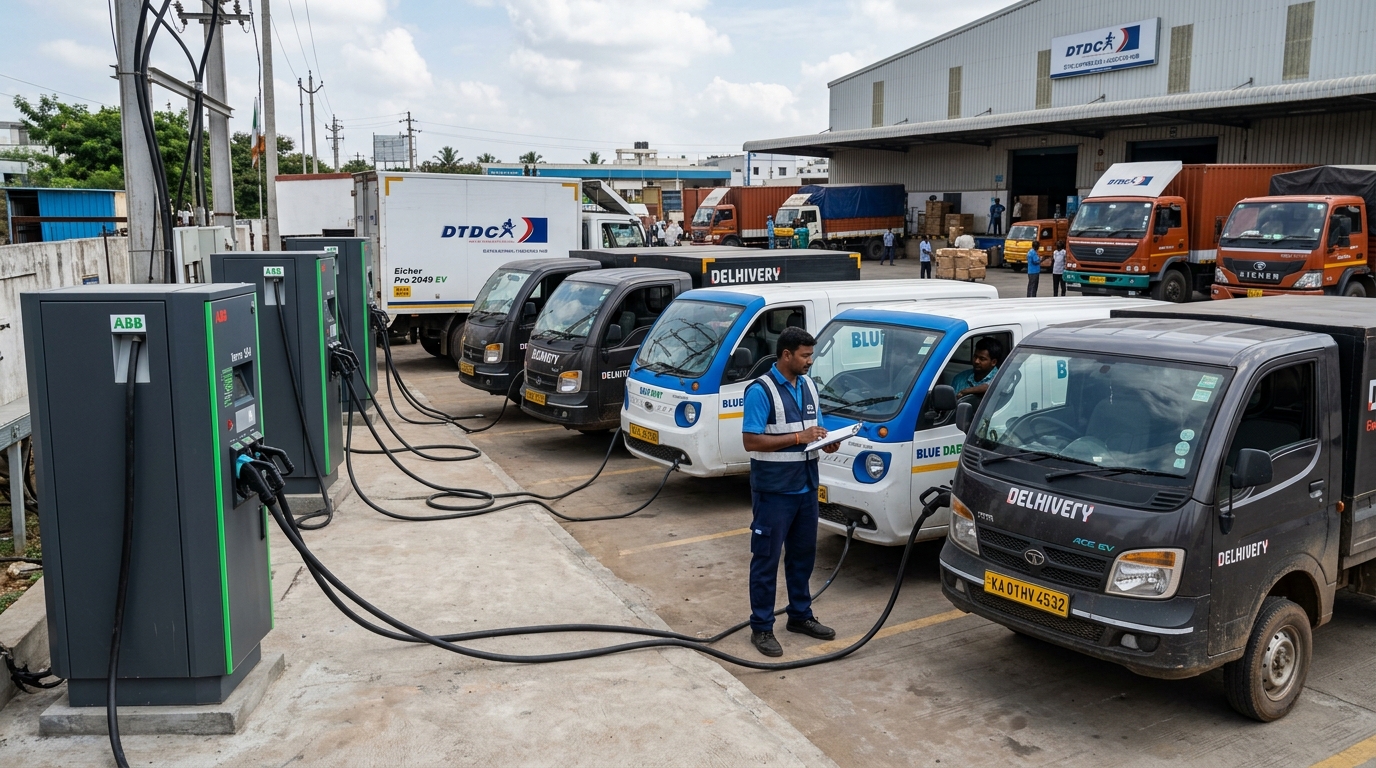
Commercial EV delivery fleet charging at a dedicated hub with smart DC fast chargers and depot infrastructure management
How Does Telematics Helps Manage EV Fleets?
Electronic vehicle telematics is a combined branch of information technology (IT) and telecommunications that focuses on sending, receiving, and storing information via telecommunication devices.
By interfacing directly with the vehicle's onboard Controller Area Network (CAN bus) and Battery Management System (BMS), telematics tracking solutions unlock high-resolution insight into electric powertrain behavior.
Key ways logistics companies leverage telematics in fleet management:
- Tracking and Monitoring Fleets: Logistics companies use GPS to monitor vehicle routes and exact locations, enabling better route planning, dynamic re-routing, and delivery time estimates.
- Vehicle Diagnosis: Collecting data points on motor health, power electronics, and thermal performance. Logistics and transportation companies utilize this data to schedule repairs and prevent costly breakdowns.
- Fuel & Energy Management: Monitoring driver behavior, reducing idle power drain, choosing shorter and terrain-efficient routes to save energy, and measuring kilowatt-hour efficiency per delivery run. (Explore our specialized fuel monitoring systems for mixed ICE and EV fleets).
- Contextualizing driving behavior: Contextualizing and monitoring driver behavior to identify safety risks and improve or optimize driver behavior for better vehicle performance and battery longevity. (Learn more about video telematics & driver monitoring).
What is EV Fleet Charging Management?
Electric vehicle fleet management involves overseeing fleet drivers' and vehicles' charging needs and ensuring the EV charging infrastructure is optimized. EV charging infrastructure planning is critical to fleet electrification success. Real-time analytics and monitoring give fleet managers deeper insight into charging behavior, vehicle state of charge, and charger performance for smarter operational decisions.
Core Features of an EV Fleet Management Platform:
Operational Management
Charger health, automated fault alerts, issue resolution workflows, and real-time charger uptime tracking.
Energy Management
Intelligent load balancing, priority charging rules, peak-shaving, and depot electrical capacity planning.
Driver Experience
Dedicated mobile app, charger reservation, plug-and-charge authorization, and public roaming support.
Analytics and Insights
Charging behavior analytics, historical SOC trends, charger utilization rates, and energy efficiency metrics.
Financial Management
Driver home-charging reimbursements, automated energy billing reports, and multi-network roaming settlements.

Fleet managers monitoring live electric vehicle battery State of Charge (SoC), route feasibility, and charging telematics
How to Monitor EV Battery Health, Range and Utilization
To do detailed EV battery monitoring, check battery health, actual EV range, and SoH, and install a telematics system.
- Battery capacity: Charge your 400 kWh truck to 200 kWh and see whether the SoC reaches 50%. This lets you verify the accuracy of the battery management system calibration in your vehicle.
- EV range: Monitor if your vehicle's actual range at a full charge is the same as the estimate given by WLTP. The Worldwide Harmonized Light Vehicle Test Procedure is the test manufacturers use to determine an electric vehicle's range. This is effectively how efficient manufacturers claim their electric vehicles are – similar to KM per litre.
- Monitor the SoH (State of Health): Your EV has a built-in battery health monitoring system. To access this information, you’ll need an on-board diagnostic device that can tap into the BMS and check your battery's overall health. Sensors and the Battery Management System (BMS) continuously measure cell voltage, pack current, and thermal levels.
- Telematics system: Installing a telematics system in your EV is one of the most accurate ways to test your EV battery health. It’ll use in-vehicle sensors and GPS to record real-time data on the battery status, charging patterns, and energy utilization.
How Can EV Fleet Management Reduce Operating Costs?
Electric vehicle fleet management is the coordinated planning and execution of routes, charging, vehicle availability, battery performance, and operating costs for fleets powered by electricity rather than fuel.
With electric vehicle fleet management software, teams track energy consumption per route, avoid unnecessary charging, and improve vehicle utilization. Over time, this lowers the cost per delivery and clarifies total operating costs compared with fuel-based fleets.
This reduces excessive buffering, avoids mid-route charging disruption, protects SLA adherence, and helps teams improve fleet utilization.
What EV Fleet Metrics Should Fleet Managers Track?
The following features are key metrics to track for an effective electric vehicle fleet management system:
| Metric | Why it matters for EV fleets | Operational outcome |
|---|---|---|
| Real-time battery visibility | Dispatchers need to know whether a vehicle can complete its assigned route | Fewer range-related failures and better SLA protection |
| Range-aware route optimization | Routes must account for usable range, stop density, payload, dwell time, traffic, and depot return | Better route feasibility and lower cost per stop |
| Charging coordination | Depot charging capacity can become a constraint as EV volumes increase | Reduced charger conflicts and avoidable idle time |
| Load balancing | Multiple EVs charging at once can strain depot infrastructure or increase demand charges | More controlled energy use and better charger availability |
| Dispatch automation | Manual assignment becomes unreliable across mixed EV and ICE fleets | Faster, more consistent vehicle-to-route allocation |
| Mixed-fleet support | Most enterprises operate EV and ICE vehicles together during transition | One operating model across owned, EV, ICE, 3PL, and gig capacity |
| Real-time control tower | Exceptions need to be detected during execution, not after service failure | Earlier intervention and stronger on-time delivery |
| Battery health analytics | Battery degradation affects range, asset value, and maintenance planning | Better lifecycle management and reduced unplanned downtime |
| Financial reporting | EV economics depend on energy, labor, utilization, and infrastructure costs | Clearer cost-to-serve, utilization, and TCO visibility |
How to Build an EV Fleet Management Strategy?
A successful EV fleet strategy connects vehicle selection, route planning, charging infrastructure, telematics and operational change management. A phased approach can help organizations validate assumptions before scaling.
Assess Your Fleet Composition
Map current routes, vehicle utilization, payload requirements, daily distance and depot patterns. Identify which routes are suitable for EV deployment and which may require different vehicle or charging arrangements.
Evaluate Charging Requirements
Assess where vehicles park, when they are available for charging, how much energy they require and what charging capacity is already available. Smart charging can help align charging with operational schedules and energy-cost requirements.
Plan Depot Charging Infrastructure
Choose charging infrastructure according to vehicle requirements, turnaround time, available electrical capacity and site layout. Security and access controls should also be considered for shared charging areas.
Use Telematics and EV Suitability Assessment
Use telematics data to analyze existing routes and identify where EVs can replace conventional vehicles without creating avoidable range or availability risks.
Start with a Controlled Pilot
Begin with a small number of EVs on predictable routes. Track battery performance, charging behavior, route completion, utilization and operating costs before expanding the program. Compare expected returns using our Fleet ROI Calculator.
Planning to scale an electric fleet?
Talk to Roadcast about fleet tracking, route optimization and EV battery visibility through its fleet-management platform.
Conclusion: Unlocking the Full Potential of Electric Fleets
EV fleet management is about coordinating more than vehicles. Fleet teams need visibility into battery status, range, charging, routes, utilization and operating costs to keep electric assets productive.
A connected telematics and fleet-management approach can help organizations monitor vehicle performance, plan routes around real-world range, coordinate charging and identify operational issues earlier. For businesses moving from pilot EV deployments to larger fleets, building these capabilities into the operating model can make electrification easier to manage at scale.
Roadcast's Fleet Management Platform provides the unified control tower, battery health diagnostics, and smart charging intelligence required to turn fleet electrification into a competitive operational advantage.
Ready to Power Your Electric Fleet with Intelligent Telematics?
Request a Roadcast live demo and discover how real-time battery analytics and range-aware dispatch can accelerate your EV transition.
Frequently Asked Questions About EV Fleet Management
How does telematics help manage electric vehicle fleets?
Telematics provides real-time visibility into vehicle location and operating data. For EV fleets, it can be used alongside battery and charging data to support route planning, battery monitoring, utilization and operational decision-making.
How do you monitor EV battery health and range?
Fleet teams can monitor State of Charge (SoC), compare actual range with expected range, review State of Health (SoH) data and use telematics to capture battery status, charging patterns and energy utilization.
How can businesses manage EV charging for a fleet?
EV fleet charging should be coordinated around charger availability, charging schedules, vehicle usage, energy consumption and the fleet's operating timeline. Smart charging can help align charging with operational and energy-cost requirements.
What metrics should an EV fleet manager track?
Key metrics include real-time battery visibility, range-aware route optimization, charging coordination, load balancing, dispatch automation, mixed-fleet support, real-time control-tower visibility, battery health analytics and financial reporting.
Is EV fleet management different from traditional fleet management?
Yes. EV fleet management adds battery monitoring, charging schedules, energy-cost optimization and range-aware planning to the tracking, routing, maintenance and dispatch activities found in traditional fleet management.