
Logistics operations across India still rely on manual data entry spread across disconnected spreadsheets, phone calls, and paper records. Managing a fleet in 2026 can't run on an outdated spreadsheet anymore. Fleet-driven industries are under more pressure than ever to cut costs, improve efficiency, and strengthen security. A proper fleet management cost analysis is one of the most reliable ways to make data-backed decisions that protect your budget and maximize profitability. As operating costs climb across logistics, delivery, construction, and beyond, knowing exactly where your money goes is no longer optional.
Why Fleet Management Software Pricing Is So Confusing
Understanding the true cost of fleet management software is the first step to protecting your budget. Cost is tied to the system you choose and depends on factors like features, software type, and development approach — so businesses need to evaluate their specific needs before comparing vendors. Fleet pricing models vary widely, which makes direct comparisons difficult.
Some vendors charge low software fees but sell expensive standalone GPS or telematics hardware; others bundle cheaper hardware into a higher monthly subscription. Basic plans often cover only simple GPS tracking, while premium tiers add fuel logs and automated maintenance alerts. Getting this comparison right matters — see our Complete Guide to Fleet Management Software for a full breakdown of features to evaluate.
Onboarding, legacy data migration, staff training, and cloud hosting fees are frequently left out of the base quote entirely.
How to Compare Pricing Apples-to-Apples
When evaluating providers, break your cost analysis down using these steps:
- Calculate Total Cost of Ownership (TCO): add up software subscription fees, hardware installation, cloud hosting, and implementation charges over a 3-year period.
- Look for specialized features: such as monthly fuel-leakage and idling-cost tracking.
- Evaluate fleet size vs. per-vehicle fees: if you run a large fleet, per-vehicle SaaS fees can exceed ₹1.5–3 lakhs annually — at that scale, a custom-built, one-time software investment often becomes more cost-effective.
Not sure what your fleet's real cost baseline looks like? Talk to a Roadcast fleet consultant.
What Determines Fleet Management Software Cost in India
Several functionalities affect the development and subscription cost of fleet management software. Here's what actually moves the number:
Number of Vehicles
Fleet size is the most direct driver of cost. As vehicle count increases, so does the cost of administration, advanced analytics, onboarding, support, and training.
Type of Fleet
Different industries run different operations, which changes system complexity and cost. A logistics fleet needs route optimization, delivery workflows, and behavior monitoring. A healthcare fleet needs compliance tracking and safety controls. A last-mile delivery fleet needs advanced scheduling and proof-of-delivery — read more in The Last-Mile Delivery Challenges and How to Solve Them.
Core Features vs. Advanced Automation
Core features — real-time GPS tracking, alerts, basic reporting — are inexpensive to implement. Moving to advanced automation such as AI-based optimization, predictive analytics, and automated scheduling costs more upfront but tends to deliver stronger long-term ROI.
Hardware Requirements
GPS trackers, dashcams, temperature sensors, and other IoT devices increase upfront cost significantly, along with ongoing maintenance and storage overhead.
Cloud vs. On-Premise Deployment
Cloud solutions are generally the more economical choice; on-premise deployments carry high upfront costs and ongoing maintenance overhead.
Integrations With Existing Systems
Enterprise clients often need integration with ERPs, HR systems, and billing tools. Frequent updates, security patches, and API version changes require ongoing maintenance — but a well-integrated system improves both operational efficiency and long-term project cost.
Compliance Requirements
Different regions carry different data-handling standards. Meeting these requirements adds cost, particularly for enterprise and government fleets.
Data Volume & Reporting Complexity
Complex reporting needs — customizable BI dashboards, predictive analytics — increase cloud resource costs proportionally.
Mobile App Requirements
Mobile app needs change the average cost meaningfully. Driver apps need navigation; manager apps need dashboards and alerts. Each app type adds its own development and maintenance overhead.
Hardware Cost vs. Software Cost: Full Breakdown
Fleet management systems combine hardware costs (upfront, for physical devices) with software costs (recurring subscription fees). For a deeper look at how GPS and telematics pricing has shifted, see GPS Tracking & Telematics Trends 2025.
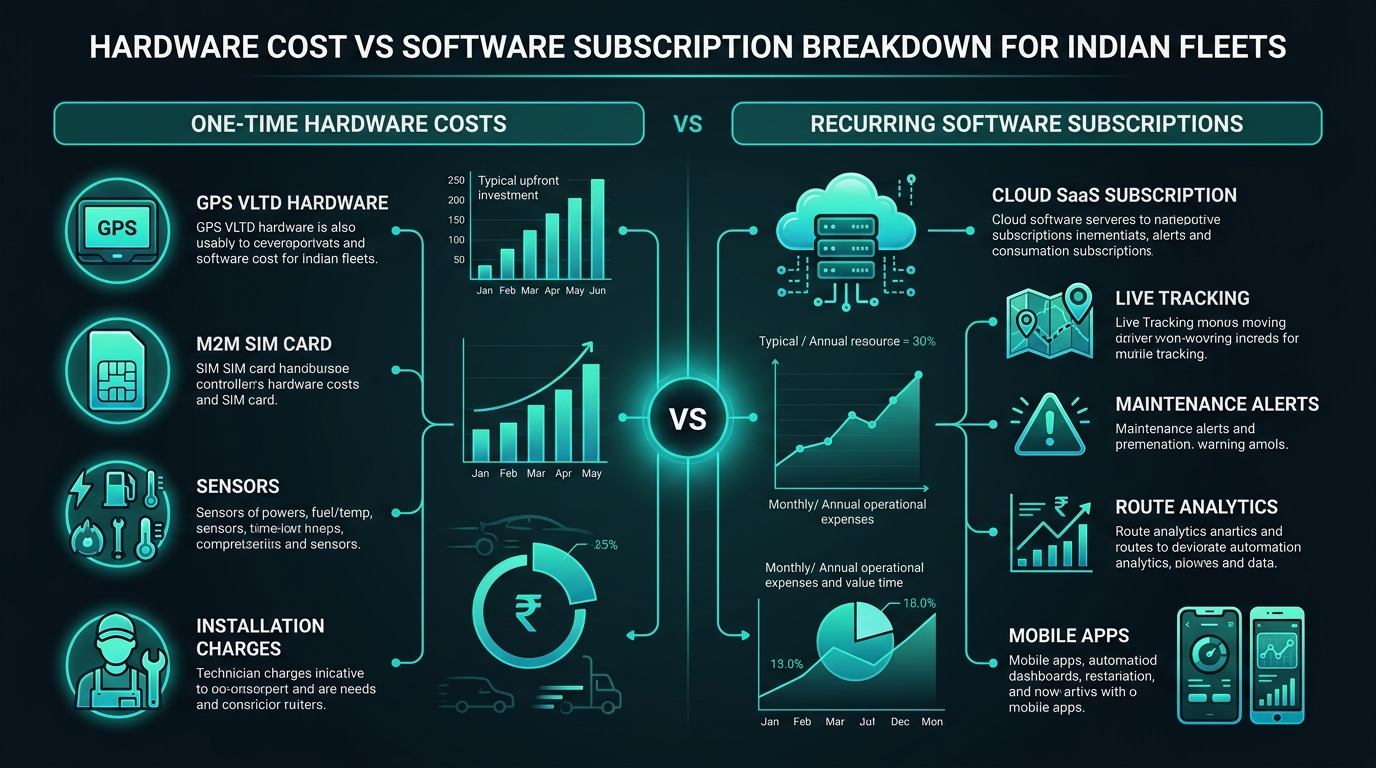
Hardware Cost vs. Recurring Software Subscription Breakdown for Commercial Fleets in India
GPS Hardware Costs in India
The total first-year cost of basic GPS trackers per vehicle runs approximately ₹4,800 to ₹15,800, covering:
- VLTD hardware: ₹4,000–14,000
- M2M SIM and data plan
- Installation: ₹500–1,000
Software Subscription Costs
Most SaaS fleet platforms bill per vehicle, per month:
- Backend software subscription: ₹300–800 per vehicle/month for live tracking, maintenance alerts, and basic reports
- Multi-year lock-in: typically comes at fixed per-unit pricing
- Custom software development: moving beyond basic tracking into ML-based route optimization or predictive maintenance requires greater investment
- Bundling models: many providers bundle hardware cost into a higher monthly subscription to reduce upfront spend
Typical Cost Drivers in Fleet Management Software
- Maintenance management
- Vehicle inspections
- GPS telematics integration
- Reporting and analytics
- Driver management
See exactly which modules your fleet needs — and what they cost. Request a Demo.
Per-Vehicle Pricing vs. Flat-Fee Pricing: Which Model Fits You?
Under a per-vehicle model, fleet management software in India typically costs ₹300–800 per vehicle/month; flat pricing instead charges a fixed tier for a set capacity.
Per-Vehicle Pricing (Per-User / Per-Asset)
- How it works: you pay a set amount (typically ₹300–800/month) for each active vehicle tracked.
- Advantages: scales directly with your business — adding or removing vehicles instantly adjusts next month's bill.
- Disadvantages: can become expensive as your fleet grows, turning into a large recurring cost.
Flat Pricing (Tiered / Fixed Fee)
- How it works: a single flat subscription covers an entire organization or a capped tier (e.g., “up to 25 vehicles” or unlimited vehicles at a set monthly rate).
- Advantages: ideal for stable, fixed-size enterprise fleets — cost stays the same even near the tier limit.
- Disadvantages: upgrading tiers can cause a sharp cost jump, and you may pay for unused capacity if your fleet shrinks.
Add-On Modules That Change the Price Tag
Add-on modules extend basic vehicle tracking with specialized tools for safety, cost control, and facility oversight.
Video Telematics
Video telematics records video from road-facing and cabin-facing cameras linked to driving events, offering visual context that helps prevent fraud, verify deliveries, and improve safety and accountability. It's worth adopting because it cuts costs, prevents accidents, resolves disputes faster, and keeps you ahead in India's competitive logistics landscape.
Fuel Monitoring
Fuel monitoring systems track fuel consumption across trucks and equipment, surfacing data on diesel usage, sudden drops, idling time, and efficiency — helping organizations cut wastage and catch sudden fuel loss immediately. Learn more in Fuel Management System & Software for Fleets.
Yard Management
A yard management system automates gate entries and exits, replaces manual check-ins and paperwork, and gives real-time location tracking of trailers and containers. Intelligent scheduling minimizes bottlenecks, optimizes loading/unloading, and reduces idling by deploying the workforce more efficiently.
Key Benefits That Drive ROI
Fleet management software is a catalyst for freight and transportation companies to lift operational efficiency. According to Fortune Business Insights, the fleet management software market is projected to reach $116.56 billion by 2032, growing at a 19.8% CAGR.
An advanced fleet management solution helps you make real-time decisions on the road without compromising ongoing operations. Here's where the ROI actually comes from:
Fuel Costs and Efficiency
Tracking driver behavior lets fleet management software spot unsafe habits — excessive idling and aggressive driving quietly drain fuel. A study by the U.S. Environmental Protection Agency (EPA) found that positive driver habits can reduce fuel consumption by up to 25%.
Fuel-anomaly alerts also help reduce fraud and theft: a sudden drop in fuel economy can signal tampering or siphoning, and the software can show exactly when, where, and how much a vehicle was refueled.
Vehicle Maintenance and Monitoring
Dashboards give total visibility into fleet activity, service history, oil changes, and mileage — simplifying preventive maintenance. Inspections of oil levels, air filters, and tire pressure are small details that jointly cut costs significantly over time.
Route Optimization
Fleet management software analyzes traffic patterns and road conditions to identify the most efficient routes, cutting unnecessary mileage. Research shows proper routing can reduce fuel consumption by 10–30%.
Paperwork and Compliance
Digitizing paperwork makes documents easier to store and retrieve, and automated reports help ensure your fleet stays compliant with industry regulations.
Cost Control
Automated reporting and analytics — especially when combined with AI-based visibility platforms — turn raw fleet data into faster, more confident decisions that improve both productivity and profitability.
Theft Prevention
Real-time GPS tracking and geofencing prevent unauthorized vehicle use and deter theft, strengthening asset security fleet-wide.
Best Practices for Fleet Budgeting
Fleet budgets vary by number of vehicles, industry, company type, operating region, and local regulations — your budget should reflect your business's own needs and constraints. As a reference point, here's a sample allocation for a mid-size fleet:
Fleet acquisition and related operational expenses account for roughly 95% of the budget, while technology and telematics account for the remaining 5% — but that 5% directly influences:
- Fuel efficiency: 25%
- Driver productivity and compliance: 17%
- Maintenance costs: 15%
- Insurance risk: 8%
That's roughly 65% of total operating costs influenced by a 5% technology spend — which is exactly why adopting fleet management software is one of the highest-leverage budget decisions a fleet operator can make.
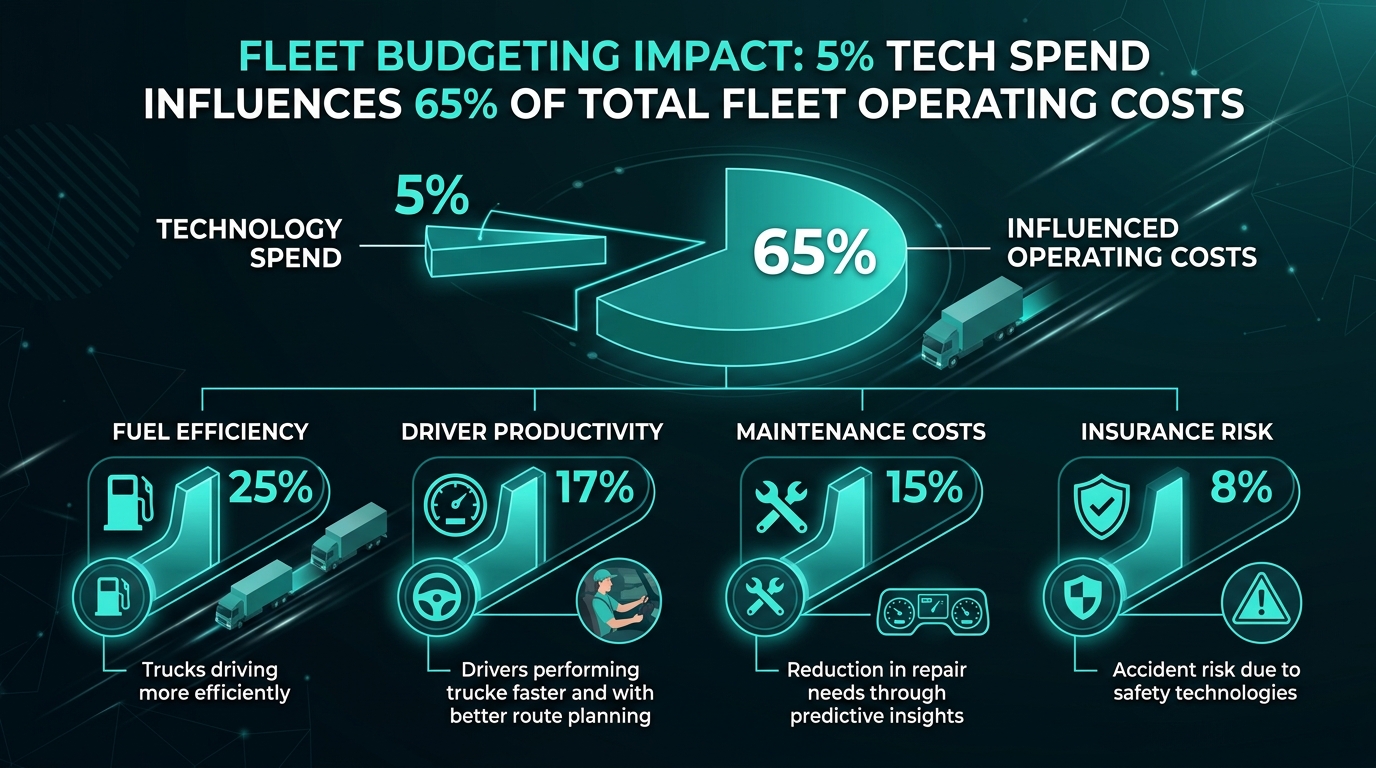
Fleet Budgeting Leverage: How a 5% Technology Investment Controls 65% of Operational Costs
Fleet Management Software Market: Statistics & Trends (2026)
- The global fleet management software market was valued at $10.01 billion in 2025, projected to grow from $11.61 billion in 2026 to $47.81 billion by 2034 (19.4% CAGR).
- North America dominated the market with a 40.76% share in 2025.
- Asia Pacific is projected to reach $2.68 billion in 2026 and $14.06 billion by 2034 (23.0% CAGR), driven by expanding logistics networks.
- India's market was estimated at around $0.44 billion in 2025 — roughly 4.4% of global revenue.
- Per the McKinsey Global Logistics Report 2025, Asia Pacific holds 57.3% of the e-commerce logistics market share, ahead of North America (24.1%) and Europe (12.6%). Within Asia Pacific, China, Japan, and India remain the largest markets, with India, Indonesia, Vietnam, and Thailand showing the strongest growth potential.
- Transportation & logistics represented the largest segment share at 30.8% of global revenue in 2025.
- Passenger cars are expected to grow at a 21.3% CAGR.
- Retail & consumer goods is expected to be the fastest-growing segment at 23.9% CAGR.
- AI & advanced analytics is expected to grow fastest overall at 23.4% CAGR.
- GPS-based solutions held the largest market share at 38.7% in 2025.
- Cloud-based platforms dominate with a 53.4% share, thanks to scalability and lower upfront costs.
- EV fleet management is accelerating fast: as commercial EV adoption grows, providers are strengthening AI-enabled energy optimization, predictive maintenance, and sustainability reporting.
How to Calculate Fleet Management Software ROI (Step-by-Step Framework)
Fleet management software ROI isn't a single number — it's the sum of multiple cost-reduction and efficiency streams that compound across your operations.
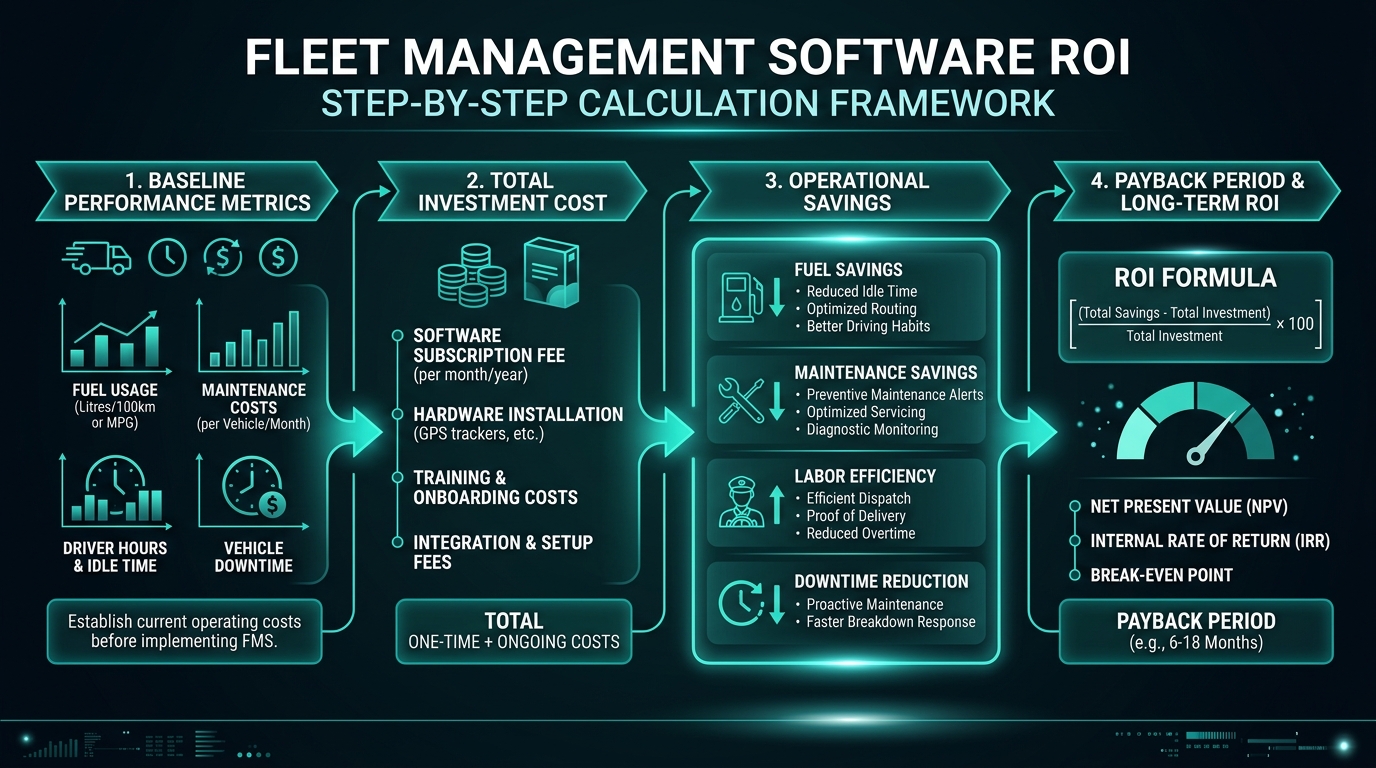
Step-by-Step ROI Calculation Framework for Fleet Management Software Deployments
Step 1 — Establish Baseline Performance Metrics
ROI is only as accurate as your baseline. Before projecting savings, record current performance for each cost category: fuel cost per km, maintenance cost per km, administrative hours spent on fleet tasks, vehicle utilization rates, and compliance violation history. Fleets without existing telematics may need to collect this manually over a representative period.
Step 2 — Calculate Total Investment Cost
Include every cost over your evaluation period (typically 12–24 months), not just the headline subscription:
- Telematics/GPS hardware and shipping
- Software subscription fees
- Professional installation and wiring
- Onboarding, IT integration, and staff training hours
Step 3 — Quantify Operational Savings by Category
- Fuel & idling: multiply reduced idle hours by your hourly fuel burn rate and fuel cost.
- Maintenance: calculate the drop in reactive repairs by tracking adherence to automated preventive maintenance.
- Administrative labor: count hours saved from automated reporting, digital inspections, and paperless logging.
- Downtime reduction: multiply saved downtime hours by your average revenue or cost per operating hour.
Step 4 — Calculate Payback Period and Long-Term ROI
Calculate long-term ROI over a 3–5 year horizon, accounting for ongoing subscription costs against accumulating annual savings. A payback period under 12 months is generally considered strong.
Formula:
Fleet Management ROI (%) = (Verified Financial Benefit − Total Investment Cost) ÷ Total Investment Cost × 100
Payback Period:
Payback Period (Months) = Total Investment Cost ÷ Monthly Net Savings
Example: If a fleet saves ₹120,000 and software costs ₹20,000 —
ROI = (120,000 − 20,000) / 20,000 = 5x (500%) ROI.
Payback period = 20,000 / (120,000/12) ≈ 2 months.
Most fleets see ROI within 6–12 months; fleets with reactive maintenance or frequent breakdowns often see savings and payback within the first 2–4 months.
Simulate Your Fleet's Financial Health
Calculate fuel savings, maintenance cost reductions, and your exact payback period using Roadcast's FourCast ROI Calculator, tailored to your real fleet metrics.
Hidden Costs to Watch For
Building or licensing fleet management software carries hidden charges organizations should plan for upfront:
- GPS hardware installation: professional installation across all vehicles adds labor cost and setup time.
- Replacement hardware: damage or theft in the field means additional replacement cost.
- SIM & data charges: real-time tracking needs SIM cards with data plans that scale with fleet size.
- Cloud hosting after scale: as your platform grows, storage, map usage, and API calls increase hosting costs.
- Extra integrations: connecting to ERP, HRMS, or accounting tools often needs custom APIs and ongoing support.
- Custom reporting: automated dashboards with custom analytics carry higher maintenance costs than standard reports.
- Admin onboarding & training: takes time and cost, scaled to the modules your team uses.
- Support/maintenance fees: after-launch support and updates are typically billed monthly or annually.
- Version upgrades: major releases can bring compatibility, migration, and testing costs.
Conclusion
Fleet cost management is about more than cutting expenses — it's about making smarter, data-backed decisions that drive long-term efficiency and growth. Understanding what fleet management software actually costs — and where the hidden charges hide — is the first step to protecting your budget and choosing the system that's right for your fleet size, industry, and growth plans.
Ready to see what it would cost for your fleet? Get a custom quote — Request a Demo.
FAQs
How much does fleet management software cost per vehicle in India?
The backend software subscription typically averages ₹300–800 per vehicle per month, covering live tracking, maintenance alerts, and basic reports.
Are there hidden costs beyond the subscription fee?
Yes. Admin onboarding and staff training take time and add cost, after-launch support and updates are usually billed separately, and upgrading to a new version can bring additional compatibility, migration, and testing costs.
What's the difference between hardware cost and software cost?
Fleet management systems combine hardware costs (upfront costs for physical devices like GPS trackers) with software costs (recurring subscription fees for the platform itself).
Is there a minimum fleet size required to see ROI?
No strict minimum. Many small-business solutions start paying for themselves with as few as 5 vehicles, or even fewer, depending on how critical vehicle uptime is to your revenue. Operational factors matter more than fleet size alone.
How long does it take to see ROI after implementation?
Most fleets see ROI within 6–12 months, though fleets with reactive maintenance or frequent breakdowns often see savings and payback within the first 2–4 months.
Related Blogs
Complete Guide to Fleet Management Software
Fuel Management System & Software for Fleets
The Last-Mile Delivery Challenges and How to Solve Them
Future of Fleet Management: GPS Tracking & Telematics Trends